Showing posts with label Young Children and Worship. Show all posts

Monday, June 30, 2014

YCW: John's Vision of a new Heaven, a new Earth, and a new Jerusalem

This is the companion story to "John, Follower of Jesus, Teaches throughout the World". You can read about the first story here and as well as view the story materials, which are exactly the same for the companion story. 

Both of these stories are about John the Apostle and his exile on the isle of Patmos. They are almost identical, except that each one deals with a different passage that John wrote from the book of Revelation.

The stories come from Young Children & Worship, another Montessori-inspired curriculum whose creator, Sonja Stewart, drew heavily upon the work of Godly Play creator, Jerome Berryman. One plus of YWC is that it has some interesting New Testament stories not contained in the Godly Play curriculum. A big minus, however, is that the stories can be too simple for children over 7 years of age. 

Last year, when I told Part 1, the children complained that it was too short and a little boring. This time I carefully thought through how to elaborate to make it more interesting for older children.  I started by explaining more about the geography and pointed that the part of the earth we were looking at is now modern-day Turkey and the Middle East. I also explained that Patmos had been enlarged so that we could see it better, and in reality it is quite tiny. 

I also added more historical details about the city of Ephesus, how it was a center of worship for the goddess Artemis, and how many people earned their living from selling articles related to worship her temple. This helped the children to grasp the larger picture of why John's teaching about Jesus might have made people angry enough to have him arrested and sent into exile. 

The story ends with the focus on a passage in Revelation about the new heaven and earth from Revelation 22 that John wrote to his friends in Ephesus while he was in exile. 

The underlay that depicts Asia Minor and the Mediterranean Sea is quite lovely, and the children were drawn to the geography during the Response Time. 

One child carefully copied the map and John's journey. Then, she fashioned a boat, John, and a ball and chain to represent his captivity out of modeling clay.


Another child re-created the entire map in miniature with modeling clay.


Sometimes, when our group is smaller, I also choose an activity during Response Time. (I find as a mentor that it is important to myself continue to wonder and create.) I chose to wonder about John's chains with modeling clay and how it would have felt to be in chains because of my faith. Then, I turned the links into a "prayer chain" and used it as a rosary of sorts to quietly pray as the children continued their work.


Monday, May 13, 2013

YCW: Dorcas, Follower of Jesus, Helps the Poor in Judea

This is another Young Children and Worship story that I've tried out with my own children. Although I have not been the biggest fan of YWC, I have been trying to keep an open mind about it until I've told more of these stories. And the story of Dorcas has some really great things in it. 

First of all, it is a New Testament story about a woman. Not many of those out there. And as someone who is consciously trying to empower young girls, I do look for stories that highlight women characters.  

The materials for Dorcas: a Dorcas figure, a Peter figure, 2 figures to represent
a widow and a poor person, and 5 tunics 

Secondly, this story communicates freedom and variety in how we show our love for God. The story begins with how the followers of Jesus received God's gift of the Holy Spirit and how they began to do the things that Jesus did.

"Dorcas did the things that Jesus did, but in her own special way." (She made clothing for the poor and for widows.)

I love this!! The last thing I want to do is mentor children to be cookie-cutter Christians who end up not truly living out the Gospel, because of social pressure to do what everyone else does. Stories like this one communicate that God values all of our gifts and talents. 

The second half of the story focuses on Dorcas' unexpected death brought on by an illness. The many widows and poor people that she has helped are distraught with grief. The apostle Peter is immediately sent for. He prays and then bids her to get up, and she comes to life again. 

Peter and Dorcas after God makes her alive again.
My kids once again complained about the length of the story. (YWC stories are in general very short in comparison to Godly Play.) But they had a lot to say during the Wondering.

I picked the following questions to wonder about:

1) How did the people feel when Dorcas was dying?
2) How did it feel for Dorcas to die and then be made alive again?
3) What did Peter say when he prayed?
4) How might the people who saw Dorcas be made alive again have shown that they loved God in their own special way?

Unfortunately, I don't remember a lot of what we talked about this time. We did talk about the special ways that we show our love to God. And we also spent a lot of time discussing what Peter might have prayed before he told Dorcas to get up.

There were also a few silly moments, because Dorcas' name sounded a lot like "dork" to my son.: ) Glad that we can laugh together and not take ourselves too seriously.

And this is a YWC story that I would definitely tell again.

A note about the materials: Obviously, I used Godly Play People of God figures instead the YWC figures. I also looked at their material list and asked myself, "What can we leave out and still have everything we need for the story?" So I chose not to use a wooden bed for the house and a water basin with cotton balls (to represent the women washing Dorcas after her death). I thought those things would ultimately be distracting and better left to the children's imagination.


Linked to Montessori Monday at Living Montessori Now

Linked to Eco Kids' Tuesday at Like Mama-Like Daughter and Organic Aspirations


Monday, April 29, 2013

YCW: John's Vision of the Kingdom of God

Young Children and Worship is another Montessori-based form of religious education developed by Dr. Sonja Stewart under the tutelage of Godly Play creator, Jerome Berryman. While I do not feel that YCW has the depth of Godly Play, I do use it occasionally to introduce new stories to my own children. I do wish there were more New Testament stories in the Godly Play curriculum. Though there is a wonderful story about the life of Paul, and both the Pentecost and Last Supper stories touch on the lives of the apostles, there are no other GP stories that deal directly with the Book of Acts. 

This past Sunday, I told my own children a story called "John, Follower of Jesus, Teaches throughout the World". It is one of three stories about John's post-Pentecost ministry found in "Following Jesus", and recounts John's exile on the isle of Patmos and letters to the churches that he wrote there.

John travels far from Jerusalem to tell other about Jesus and show the ways of God's Kingdom. The people begin meeting in groups called churches. In Ephesus some people do not like what John is saying and arrest him. He is exiled to the island of Patmos.


This scene shows John's travels and his exile on Patmos.
John wants to write to his friends in the churches, but it isn't safe. He begins to write in a secret code that only his friends can understand. He writes to them about his vision of the Kingdom of God.


The yellow circle represents the spread of the kingdom of God and the scroll
contains a verse from the book of Revelation.
This scroll contains part of the "secret" message, found in the Revelation 21: 1-4:

"I saw a new heaven and new earth . . . and I heard a loud voice from the throne saying, 'Behold, the dwelling of God is with people. God will live with them, and they shall be God's people. God will wipe away every tear from their eyes, there shall be no death, there shall be no sadness, or crying, or pain anymore. The old way is gone . . . God is making everything new."

While the above description isn't the exact text due to copyright laws, it's pretty close. One of the problems in doing YCW with older children is that the stories tend to be a little too short, especially if the kids are used to Godly Play. (This can, of course, also be an advantage when working with 2-5 year-olds.) As soon as I finished the story and began the Wondering, my daughter (age 7) complained that the story had been too short. However, the Wondering proved to be quite deep, so maybe the length of the story wasn't so bad after all. It seems to have forced them to stop and take a closer look at the scripture.

I asked the following Wondering questions (the first one I made up and the second and third are from the book):
- What was your favorite part of John's secret message to his friends?
- What do you think his friend wrote back to him?
- What do you think they would have drawn in response to John's vision of the Kingdom of God?

My son hastily answered that his favorite part of John's message was that there would be no sadness. But then he thought for a moment longer and said that he didn't know how things would be without death and pain. 

"Maybe it would be good to not have death, but there has to be pain. Otherwise there would be no stories like 'Star Wars'," he said. 

I realized what an important thought that was. Pain is such a constant companion in this world that it really is difficult to imagine it being completely eradicated. It is so engrained in us as human beings that every good story has a conflict. We simply can not comprehend what existence without it will mean. My wondering about that continued long after we were through.: )

That whole conversation led to my daughter wondering what the new heaven and new earth will be like. Will they be real places? When it says that God will live with us, does that mean that we will be able to see him and talk to him face-to-face?

By the time we got to question three, both kids were pretty tired of thinking so hard, so they erupted in giggles and silly answers - their reward for so much deep theologizing. (If only all theological conversations led to laughter . . . !)

There is a companion story to this one called "A New Heaven, a New Earth, and a New Jerusalem". The text is exactly the same except the "secret message" (Revelation 21:22-26) and the Wondering questions that deal with the theme of God being our light in the new creation. I am not sure if I will try it, but I may make a scroll of the text and use it in an evening devotional.


Has anyone else out there tried this story? What have your experiences with it been?


A Note on Geography: Older children may want to know where to find this part of the world on the map. I would definitely explain to them that Patmos is enlarged for the story. In reality, Patmos is so tiny in comparison to modern-day Turkey (Asia Minor) that you can hardly see it.


Linked to Montessori Monday at Living Montessori Now


Friday, July 13, 2012

Parable of the Two Sons

A few weeks ago, I shared the Young Children and Worship story, The Parable of the Two Sons, from Matthew 21:28-32. In general, I feel that YCW stories lack a certain depth that Godly Play stories possess. Following Jesus, the second of the YCW books, says that it is a resource for three to eight-year-olds. Godly Play, on the other hand, can be quite effective with adults. I do tell YCW stories, though, mainly because there are some interesting biblical accounts that are not included in the GP "canon". Like this one.

At first glance, one might think this is the story better known as the Prodigal Son. However, Jesus told this parable when the religious leaders of his day wanted to know where his authority came from. In this parable, a father asks one son to work in the vineyard. The son says, "No," but then changes his mind and harvests the grapes anyway. The second son, when asked, replies, "Yes," but then refuses to do the work.

The story ends with Jesus telling the religious leaders that the tax collectors and sinners are like the first son and that they themselves are like the second son. The tax collectors and sinners changed their ways and will come into the Kingdom of God first.

On the one hand, the YCW story does very clearly explain the story to the children who are listening. Indeed, the children who heard this story were paying very close attention, even an 8-year-old who was present. But somehow, the story was more of a "retelling" of the parable and something was missing for me. The mystery was lacking and there wasn't much to wonder about at the end. However, I would definitely tell it again to children, to help them become familiar with this story.

During the Wondering, one of the children present seemed to identify with the second son. "Because I don't always obey my parents," he said. Interesting . . . 

The materials above are from Worship Workworks. While beautiful, they were very expensive and were a gift from my mother to our children's ministry.

Do any of you do YCW as well as Godly Play? How do you feel about the differences?

Sunday, June 12, 2011

Pentecost (Whitsun)/Pfingsten

Today we celebrated Pentecost (also called "Whitsun") at Family Brunch. On this special day, the church celebrates two things:  1) God's gift of the Holy Spirit to all believers and 2) the birthday of the worldwide church.  Our children at Haus Berlin e.V. heard two stories from Young Children and Worship that I combined for this special occasion.

The first story, entitled "Pentecost" Sonja Stewart's book, follows the account in Acts 2 of the first followers of Jesus who gathered in the upper room waiting for God's gift of the Holy Spirit just as Jesus had asked of them.  This YWC story does a great job of explaining what happened, but also leaving things to the children's imagination.  After all, how exactly does one explain a rushing wind filling the room and tongues of fire appearing over people's heads?  Rather than using visual objects to tell those parts of the story, the storyteller uses specific hand motions that are faithful to the text, but also leave the children to visualize with their own imaginations.  (I feel this is very important, because the Biblical text was written by a first century author and it is difficult for us as 21st century readers to know exactly what St. Luke was describing.) And rather than emphasizing the supernatural events, the story places emphasis on the effects that this filling of the Spirit had on the followers of Jesus:  joyous love for God and other people.

As you can see here, I had a hard time getting the figures to stand up on the uneven ground.
Perhaps I need to use the art boards underneath the felt next time.: )
The second story that I told was from Stewart's second volume of stories, Following Jesus, and is called "God's Gift of the Holy Spirit". In Stewart's original story, she lists seven gifts that followers of Jesus receive and bases them on texts from Isaiah 11 and Acts 1. Because I come from a slightly different theological background than she does, I found it a bit of a stretch to say that these seven gifts were what the original believers received.  I was much more comfortable with using St. Paul's list of nine spiritual gifts listed in 1 Corinthians 12.  Although I would not say that Dr. Stewart is wrong in her understanding of the seven gifts in her original story, the original text about Pentecost only infers, but does not directly state what those gifts were. Therefore, it makes more sense to me to base the story on a text that is clearer on the subject. 

"God's Gift of the Holy Spirit" materials
We had a free response time for the creative phase today. Below you can see my set-up of materials laid out in a row on trays for the children to choose from.  They had two different types of paper, paint, crayons, and oil pastels, paintbrushes, bowls for rinsing, and sponges.  I think it is important to vary the paper that the children use.  Otherwise, they get too used to one size and one way of positioning it. Varying the paper reinforces good problem-solving skills and going into new situations with confidence.

Just in case you're wondering, the Sprite bottle
 is filled with water for rinsing brushes. : )

Hard at work.
The girls loved the colored paper.
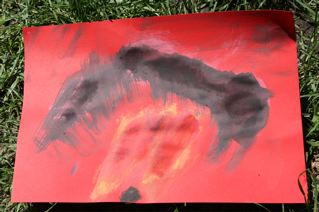
 One little girl was discussing her painting below with me.  She said that the black represented the "storm" (The YCW story describes the rushing wind in the upper room as being like wind in a storm.) and the red and yellow below were the fire. As we talked further, I realized that she had viewed the strong wind as being something negative and scary.  Hmmm . . . I might have to rethink how I describe the wind next time.

A normal part of a Godly Play worship service is the feast time, which is a snack that also prepares children for the idea of taking communion.  We usually don't do this at Family Brunch, because we eat together beforehand, but I decided to try it today.  I set the timer for 15 minutes of creative work and told the children that we would then take a break to pray and eat together, and that they could return to their work afterwards.  The prayer time actually went much better than usual this way.  In the past, I have tried the prayer time right after the story, but it has proved difficult for the children to concentrate that long.


At the very end, we put a birthday candle on our special cupcakes and the girls served them to the adults. They also picked flowers from the park to decorate the plate.


Happy Pentecost to everyone!   Happy Birthday, Church! 
And thank you, Father, for the gift of the Holy Spirit!

Monday, May 30, 2011

Sunday in the Park

The weather in Berlin has warmed up enough that our bi-weekly Family Brunch can meet in the park again.  How wonderful it is to meet with God right in the middle of his wonderful creation!  This week I combined two Young Children and Worship stories, "Jesus Commissions the Disciples" and "Ascension".  Das Wetter in Berlin ist endlich schön geworden und wir dürften den Familien Brunch (ein Angebot von Haus Berlin e.V..) draußen im Park veranstalten. Es war wunderschön Gott mittendrin in seiner Schöpfung zu begegnen! Diese Woche habe ich zwei Geschichten von Young Children in Worship, "Jesus gibt seinen Jüngern einen Auftrag" und "Himmelfahrt", kombiniert. 


The story time was actually a bit rough this week, because the children were so distracted by having church outside for the first time in a long time. But that was okay.  It was exciting to be outside and who wouldn't be distracted by the adorable squirrels and cool bugs?  Das Erzählen von der Geschichte ging ein bisschen schief diese Woche, da die Kinder so  aufgeregt waren den Kindergottesdienst zum ersten Mal draußen nach dem langen Winter zu haben.  Aber das war in Ordnung. Es war einfach toll im Park zu sein und wer hätte sich von den niedlichen Eichhörchen und faszinierenden Insekten nicht ablenken können?


One of the activities that the children could choose from in the Creative Phase was the Ascension Art Project that I wrote about in my last post.  In addition to the artistic aspect, this project involved counting (the children had to make 11 dots for the 11 disciples and 2 white dots for the two angels) and recognition of emotions (I asked the children to imagine how Jesus' friends felt when he left them and if they were happy, sad, surprised, angry, etc.). Während der Kreativphase gab es mehrere Möglichkeiten.  Eins davon war das Kunstprojekt zu Himmelfahrt, die ich im letzen Post gezeigt habe. Zusätzlich zu dem kreativen Aspekt, konnten die Kinder die Zahlen üben, indem sie 11 Püntkchen für die Jünger und 2 für die Engel malen mussten.  Auch habe ich die Kinder gefragt, wie die Jünger sich gefühlt haben als Jesus plötzlich weg war.  Das war eine gute Gelegenheit für die Kinder unterschiedliche Emotionen und Ausdrücke zu überlegen. 

Painting the mountaintop.
Ein Kind malt den Hintergrund.
Drawing the disciple's reactions to
Jesus' ascension with a felt-tipped pen.
Dieses Kind malt die Reaktionen 
der Jünger mit einem Filzstift.

The finished paintings made me smile! Die fertige Bilder haben mich total gefreut!


I set up two Montessori Practical Life activities for the children to choose from as well.  The first one, pictured below, involved stringing buttons in the shape of ladybugs, butterflies, and other insects onto pipe cleaners.  Es gab auch zwei Montessori Angebote vom Bereich, "Praktisches Leben".  Bei der ersten unten sollten die Kinder Knöpfe in der Form von Marienkäfern, Schmetterlingen, und andern Insekten auffädeln.


In the second activity the children used tongs to find and transfer acorn shells from a bowl of sand into the compartments of an ice cube tray. Bei der zweiten Aufgabe sollten die Kinder einen Pinzette benutzen um Eichlen vom Sand in eine Eiswürfelform zu übertragen


The older children who could read had the opportunity to put together the words of the Great Commission.  The control card is in the bottom right hand corner. Die älteren Kinder konnten die letzen Worter, den Auftrag, von Jesus puzzeln. Die Kontrollekarte ist unten rechts.


This was the first time that I have set up a focus table outside.  It looked so beautiful surrounded by the plants in the park.   Ich habe zum ersten Mal einen Fokustisch im Park aufgestellt.  Mit den ganzen Pflanzen herum sah es hübsch aus. 


Have a wonderful Ascension! We get the day off here in Berlin, so we are especially excited! Bis zum nächsten Mal!


Linked to The Magic Onions

Sunday, February 13, 2011

Follow me!


After battling the flu and bronchitis for several weeks, I was very glad to be at Familienbrunch (Family Brunch) with the children from our church-planting project.  We are following the church calendar and have now entered into a series on the life of Jesus.  This week we heard the story called “Follow Me!” where Jesus ministers to people along the Sea of Galilee and calls his first disciples.  We are using material from Sonja Stewart’s Following Jesus book that draws from Godly Play and the work of Jerome Berryman.  (Unfortunately, neither of Dr. Stewart’s books have been translated into German, so I have to do my own translations.  If any of my German readers are interested in having access to my translations, just write me an e-mail and I’m happy to share.)

Here are some pictures of the materials that I used.  The figures are from Worship Woodworks in the States and from the Diakonie Leipzig that makes Godly Play materials in Germany.  The beautiful boot was made by one of my daughter’s teachers in the Nature Kindergarten that she attends.


“Follow Me!” is told in a lovely way that keeps the children’s attention and introduces them to the mystery of God.  The entire story is told without mentioning Jesus’ name – only the things he does and how he interacts with the people.  Then during the “Ergründungsgespräch” (“Wondering Phase”),  the storyteller asks the question, “I wonder if this man has a name?”  Of course, most of the children know already, but it is still a beautiful moment of revelation.  At the end of the story, I taught the children the song, “Jesus kann alles”, by Daniel Kallauch, which marvelously reiterates what was in the story.

Each week we have a time of prayer after hearing the story. Each child has the opportunity to pray, but does not have to.  I pass around a seashell or some other object from nature, and the child holds it while praying. Then it is passed to the next person when he is finished. Likewise, if the child does not want to pray, he passes it along, so that the next person knows it is their turn.  Since our story had to do with the sea, we passed around a shark’s tooth today that I found at a flea market.  (I love connecting children to nature, so I take every chance I get!)  I was encouraged this week, because a child, who for a long time was quite bothered by other people praying, chose himself to pray a very short, but sincere prayer.  I truly love observing the journey of children forming a relationship with God!
 
The lovely shark's tooth from Morocco via a flea market in Berlin.
 For the creative phase I offered the children acrylic paints.  This week I did not have a specific project, because I try to find a balance between the projects and allowing the children to freely process what is going on in their hearts and minds.  I do, however, tend to stick with one medium for several weeks, so that the children really get to know what they can do with that particular medium.  
 
An almost 4-year-old working with lots of color.: )

A 6-year-old thoughtfully planning his work.

Here are some of the children's responses:
This child painted a family of squirrels that after seeing them in the park frequently on his way to school.
This child painted dinosaurs after having thanked God for making them during the prayer time.
The almost 4-year-old told me that this was the desert.  She has drawn many desert paintings and I  think she is still thinking about the Old Testament stories that take place in the desert.  
Of course, playing with the story is always an option, which these two children chose.  The disciples are now sleeping, and the fish nets have become blankets for the baby sleeping peacefully in the boat.

I wish you a wonderful week!

Sunday, January 16, 2011

Jesus Feeds the 5,000 (and we feed the birds!)

This week at Familienbrunch (Family Brunch) the children heard the story of Jesus feeding the 5,000 with 2 fish and 5 loaves of bread.  For most stories about the life of Jesus, I use Young Children and Worship and Following Jesus by Dr. Sonja Stewart, because Godly Play actually does not have many stories outside of Christmas, Easter and the parable genre that tell the stories about Jesus found in the four Gospels.  Dr. Stewart co-wrote the first book with Godly Play creator, Jerome Berryman, and she developed much of her concept with Dr. Berryman.  Unfortunately, these books have not been translated in to German, so I have to do my own translations when I use these stories!  Also, on a side note, the German Godly Play Foundation is currently in the process of developing its own stories about the life of Jesus, but I have to wait until 2012 to get them.: ) 


After wondering with the children about how the fish and bread tasted to all of those hungry people and what the disciples thought about it all, we sang a song together (“Ein guter Vater” by Daniel Kallach) about God being a good father who provides for us. I paraphrased the end of Matthew chapter 6 with the children where Jesus says that we shouldn’t worry about what we will eat or drink, because our Father in heaven loves us and will take care of us, the birds, the animals and the world.  Then, I explained that God often provides through his children and that we can be God’s helpers.  And what better way to start  being God’s helper than feeding the birds here in the middle of winter?

So I offered the following project as one of the options during the creative phase (playing with the story and art are always two of their options) that we always have after the Bible story in our worship service: making bird feeders out of orange peels to hang in the trees.  I found this awesome project on the Naturkinder blog, a great source of creative ideas for bringing children in contact with nature.  Carolina’s recipe on the blog calls for beef tallow, but try finding that in the middle of Berlin!  So we substituted peanut butter instead.: )  You can just imagine what me, the kids, and the floor looked like after mixing peanut butter, bird feed, and raisins and then stuffing them into orange peels! 


Let the fun begin!


My son climbing up in a tree to hang one of the feeders.

One of the finished bird feeders hanging in the park near our home.

All the snow has melted here, so perhaps the birds aren’t quite as desperate as they were a couple of weeks ago, but I wanted to do this project to help teach the children responsibility for this beautiful world that God has given us.  I am convinced that bringing children into contact with the Father’s creation is vital to their spiritual and social development, but more on that in my next blog. : )


Monday, November 8, 2010

Joshua and the Promised Land

At our Familienbrunch (Family Brunches), we've been following the story of the Israelites from Abraham on.  I always start by bringing out the Wüstensack (Desert Sack) that you see in the middle here. 


This week I told the children the story of Joshua and the Israelites entering the Promised Land.  The story came from Young Children and Worship, a book that Godly Play founder Jerome Berryman co-authored with Dr. Sonja Stewart.


After the story, we sang some songs together and the children had an opportunity to pray together.  Then we began the "creative phase" in which the children are able to express their thoughts or emotions about what they have heard and experienced or spend time with God.  The children can either spend their time playing with the desert sack and figures from the story or they can choose to work with the art materials.


Today was a typical day in which I laid out materials in trays for the children to choose from rather than having a project that was instructional. The children could choose from oil pastels, collage material, chalk pastels and beeswax crayons. And some of the children used all of the mediums.  


Sometimes the children draw pictures directly related to what they have just heard.  Many times they draw something that they have heard several weeks before.  And other times, they draw things that they have experienced in everyday life, which is also very important.  This boy is drawing a pumpkin because he was at a pumpkin carving at our house the day before.