Monday, May 14, 2012

Highlights from Easter in Texas

I'm just getting around to posting pictures from our time in Texas. We were lucky enough to be there over Easter and the weather was just gorgeous. Here's a glimpse of some of the ways that we relaxed and had fun.

One of the best things was chasing around my 2 1/2 year-old niece that I don't get to see often enough.


And watching her with my 6-year-old daughter in their matching dresses . . . 


Pretty cute kids . . .


We also spent time in the Hill Country swimming with friendly dogs . . .


Climbing trees . . . 
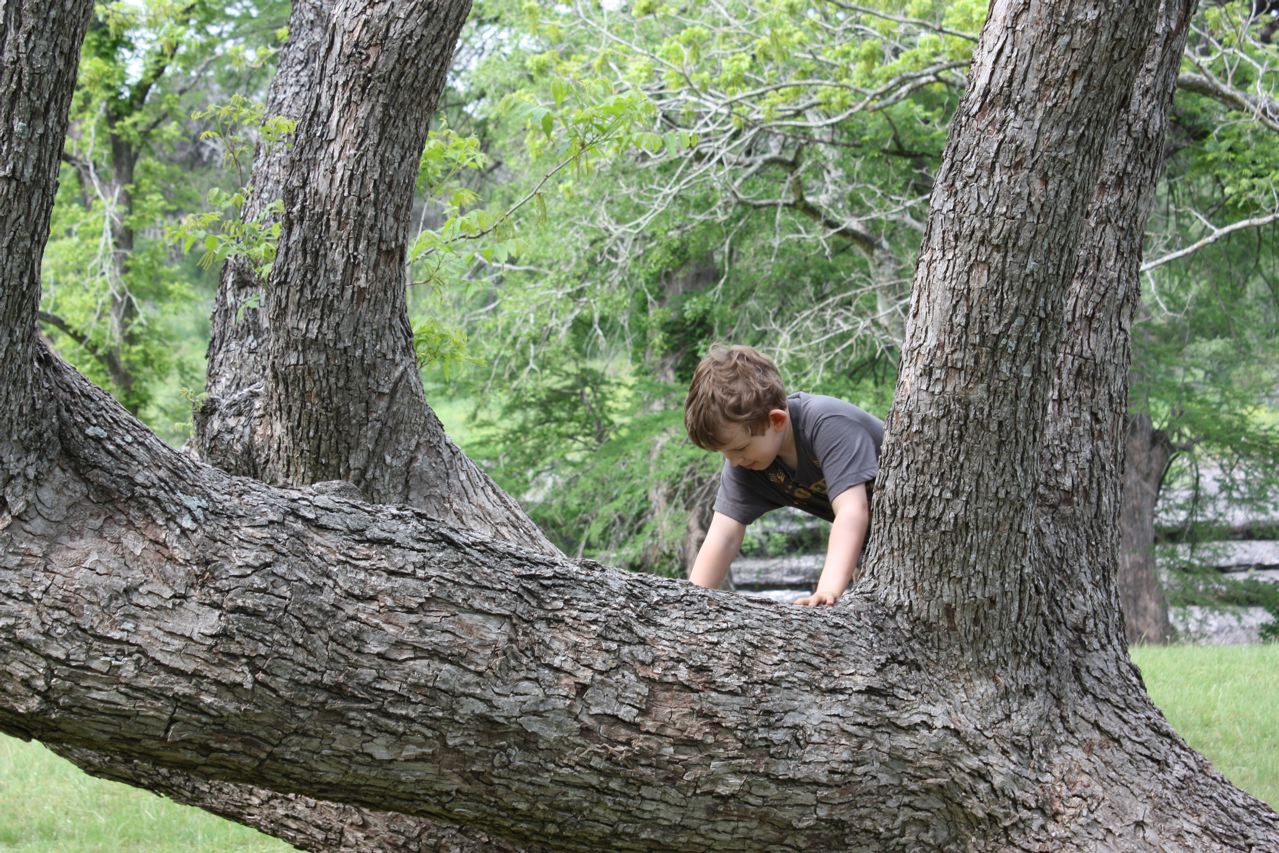

Exploring nature . . . 


And enjoying the bluebonnets . . . 


Back in Houston, we played in Grandmama & Grandpapa's pool . . . 


Did a spontaneous botany project with Grandpapa . . . 


Hung out with my sweet mother-in-law, whose life work was teaching elementary school students and raising two exceptional sons (one of whom I married!) . . . 


Did I mention that we loved how everything was in full bloom?


 And I even managed to read something that has nothing to do with Montessori, education or children's spirituality.: )


Linked to Happy Family Times at Crafty Moms Share and Happy Whimsical Hearts


Saturday, May 12, 2012

Listen more, Speak less

Once I was chatting with my daughter's former dance teacher and asking her how my daughter was doing in the class, since my daughter rarely mentioned what she did there.  I was more than a little shocked when the teacher commented that, of course, my daughter doesn't speak much about the class, because "small children don't have the means to reflect on things". As someone who works with children, I know this to be completely untrue. Even toddlers can and do reflect on a regular basis. Sadly, we adults often miss these golden moments, because children most often reflect in non-verbal ways and need time and space to transform their thoughts into words. 


At the recent Godly Play conference in Belarus, Peter Privett gave some helpful hints at how to draw children out and allow them to process verbally. His main advice was to "listen more and speak less". A helpful thing to do is to count internally to seven before answering a question or comment. We adults always think that we need to fill the empty space in conversations, but children often need that space to get their thoughts out before we inadvertently change the direction of the conversation by jumping in too quickly. 


Another practical thing to do when a child asks a question is to gently "throw the question back at them". In other words, don't answer the question for them right away and assume you know where they are going with the question. He gave the example of a little boy who asked him what kind of car God drove. Peter paused and then asked, "What kind of car do you think God drives?" The little boy thought for a moment, answered that God probably drove a Volvo, and this led to a deeper conversation between the two of them about the kinds of things that God likes. 


This should be a no-brainer, but it is important never to laugh at children, even if we are just "laughing with them". Even if we think a particular answer sounds cute, the child may be getting at something deeper than we realize. Children definitely want to be taken seriously and will stop conversing with people about spiritual things if they feel that they are not. 


Okay, please know that I am learning these things, too, so I hope that this doesn't sound judgemental in any way. I kicked myself quite a few times when Peter spoke about what not to do, because I had done almost all of them.: )  Let's just agree to listen more and speak less with the kids we walk with, okay? 


Thursday, May 10, 2012

Eastertide Guest Post #5: On the Emmaus Road

Featherglen came up trumps for our Eastertide Guest Post series with not one, but two blog posts. I introduced her in yesterday's post about her Eastertide garden. Today she shares several ways of telling and remembering the story of the Emmaus Road. I appreciate how sensitive she is to the context of worship - the community, the physical location, the resources available. It's wonderful that she's included so many photos (please honor her request, "If you want to use any of them, please be lovely enough to ask me first."). We took the liberty of re-arranging them slightly, dividing the post into an introduction and then three sections.

Although all the accounts of the Resurrection are amazing, one that I particularly love is the appearance of Jesus to two disciples on the road to Emmaus. Yes, it is strange that they don't recognise Him - but then they aren't expecting him either - somehow He is the same but different - that's certainly what I'm hoping for myself anyway! What I love is that He doesn't just jump in and shock them and say 'I'm back!' but takes the time to walk with two grieving, wondering men. He walks alongside them, listens to them and then starts to help them put the pieces together. It is only in the breaking of the bread that finally they see Him. It certainly reminds me of my own encounters with Jesus.


For us in L'Arche, it has been a powerful theme, that God walks with us . . . 

To read the rest, please join us again at Wonderful in an Easter Kind of Way


Wednesday, May 9, 2012

Eastertide Guest Post #4: An Eastertide Garden

This week's guest post is from Featherglen, a new friend, that we met through the Celebrating Lent link party. She and her husband both work as members of the L'Arche community in Inverness, Scotland. Her sidebar list of topics shows her major concerns to be her faith, her family, handicrafts, and the L'Arche Community. Featherglen's life sounds very romantic - living in the Scottish Highlands, married to a French jeweller and gardener, members of an international movement building faith-based communities with people with learning disabilities, supporting them to reach their full potential... yet her writing is honest and down-to-earth.


As a mother, member of a L'Arche Community and a church, Lent can, ironically, turn into a very full time. Although this is usually in a good way, by the time Easter has arrived and been celebrated in various ways, I'm ready for a break. However, despite not growing up in a liturgical tradition, I have grown to appreciate many aspects of such a way of worship, Bible reading, and the sense of celebrations in their appropriate times. This is sometimes also very helpful for the adults with learning disabilities that  are at the heart of L'Arche. Advent and Lent are two very important times of the year for us and we take time to deepen our relationship with God during them. I came across Godly Play when looking for ways to share the biblical story creatively, and it seemed to be instinctively right for us. One story I love in Godly Play is the Circle of the Church Year and as a family we have been very struck that 'You can't keep Easter to just one Sunday, so it keeps on for six more weeks'. I find it very liberating knowing that there's no hurry to celebrate Easter - we have all the time we need!


 In our family we made a 'Lent garden' - a large plate filled with sand and a bare branch, along with a wooden figure of Jesus, representing his time in the wilderness. It sat on our kitchen table and we added a stone each day at dinner time. By Palm Sunday we lifted out the stones, added some soil, then replaced the stones into a path to the bare branch. We sowed some wheatgrass seeds and made a tomb from clay, giving it time to dry out. A cross was added on Good Friday . . .


To read the rest and see how this beautiful Easter garden has slowly came to life, please join us at Wonderful in an Easter Kind of Way.


Monday, May 7, 2012

Pysanky Part 2 (with kids!)


Just before Easter, I learned to make Pysanky (Ukrainian Easter Eggs) at a workshop here in Berlin. I was then quite eager to try it out with my own kids as part of our Eastertide activities. So I ordered A Kid's Guide to Decorating Ukrainian Easter Eggs that came with the dyes, beeswax, and a kistka (the tool for applying the beeswax).

I tried it out first with my 8-year-old son, who really enjoyed the experience. The most difficult part for him was drawing the actual design on the egg. I suggested that for the first egg, we should actually try to follow one of the designs in the book, in order to learn how it's done. Not an easy thing for this creative fellow to do!


He had no big problems applying the beeswax with the kistka, although there were a couple of splatters here and there. One potential problem for children is that they load too much beeswax into the kistka and then it comes out in a blob on the egg. This definitely happened a couple of times. I also think an art exercise like this one helps children to learn patience. Making pysanky is a tedious, but rewarding process.


I also decided to limit the colors to four (yellow, orange, red, green)  until we got the hang of what we were doing. I added blue to our third round.


This is what the egg looked like after the final color of red was added:


Here is the fun part where we melt the beeswax and rub it off with a tissue to reveal the design. Afterwards, you need to varnish the eggs with a non-water soluble medium. Then, you can either blow the inside out or leave the egg intact. 


Our first two eggs looked like this:


In our second round, my six-year-old daughter joined in. She also enjoyed applying the beeswax with the kistka. The process proved to be a little long for her and she became a bit impatient towards the end. Her egg was not as detailed, but still very beautiful.


As with anything, practice makes perfect. The pencil drawing on my son's second egg was much better this time.


Here are all of our finished eggs. They are on our table and we enjoy looking at them as we eat!


Linked to Keep Calm Crafting On at Frontier Dreams

and Friday's Nature Table at The Magic Onions


and Sharing Saturday at Crafty Moms Share and Mama Mia's Heart2Heart


Saturday, May 5, 2012

Godly Play in Belarus

Last weekend, I had the pleasure of attending the First Belarus International Godly Play Conference in the capital city of Minsk. I met some amazing people, had excellent food, and got to share about Godly Play in one of my favorite languages. It was a gift from the Father and a weekend I will never forget. You will see some beautiful photos below from Alyona Jasuk, who photo-documented our time together.

Over 50 people from at least four different churches attended. The main speaker was Peter Privett, an authority in the field of children's spirituality, who along with Rebecca Nye, is a sort of Godly Play "apostle" to Europe as he has helped bring GP to Germany, Finland and now Belarus. Peter began our time by teaching on the theological and pedagogical principles of children's spirituality. This was so important, since without an adequate understanding of children's spirituality in the Christian context, Godly Play can be reduced to just another  cute way of doing children's ministry with expensive 3-D materials. 

Here is Peter with Tanya, who gets a medal for tirelessly translating the entire weekend. 


Peter came prepared with his presentations in Russian. Here, he is teaching on an idea from Jerome Berryman about the ethics of blessing. According to Berryman, to bless means to "call out everything that is good" in a person and that this understanding should permeate everything we do with the children we shepherd. 


This is Olga, who graciously opened her home to me and introduced me to some Belarusian culinary delights. She is chatting with Helen Spencer, who along with her husband, Nigel, organized the entire conference. 


After the sessions on children's spirituality and an introduction into the theory and practice of Godly Play, it was time to experience Godly Play. After all, what good is talking about GP if you can't get inside one of the stories? The conference participants could choose two of four stories to attend. Below, Peter presents "The Holy Family".


Anita, a guest speaker from Latvia, presented "The Exodus".


I did manage to learn "The Faces of Easter" in Russian and had a blast presenting it. Funny, it didn't seem nearly as long of a story as when I was learning it! I told the story twice. In the first group, most of the Wondering was non-verbal, and in the second, the group was much more chatty. So interesting how the Wondering was so different each time, but equally valuable. That is the beauty of God's narrative - though the biblical stories themselves do not change, they speak to us differently each time we hear them. 


Helen told the parable of "The Great Pearl".


Afterwards, I gave a workshop on Godly Play at home and at school. One of the things that I emphasized is that with a little planning and prayer, you can do Godly Play anywhere. Many people were relieved to hear that one doesn't necessarily have to have a Godly Play room in order to create spiritual space for children. (Peter also did a great job of explaining how to implement GP in small steps or phases, so that it is not overwhelming for a church to start moving in that direction.)

Another thing that we strove to communicate is that Godly Play doesn't require buying expensive materials. All of the speakers brought things we had made to demonstrate this. I showed a lot of pictures from Storyteller in Finland and Asmic in Moscow, who have made their own materials.

Here are People of God figures that Helen made out of polymer clay . . . 


And here are Anita's 10 Best Ways to Live in Latvian made from thick cardboard. (Isn't it thrilling to see Godly Play materials in other languages?!!)


I was very encouraged by the number of young women  . . . 


and young men that attended the conference. (The average age of the GP circles that I run in tends to be a little older!) Wish I had discovered Godly Play at their age, but better late than never.: )


Here Pastor Dima gives Helen a rose in thanks for her hard work in organizing the conference. I was impressed by this man, who recognized the importance of the children in his congregation and fully supported his children's workers in implementing Godly Play. So important for the children in any congregation to have a wise leader who values them.


I left with the feeling that this was not the last time that Godly Play will bring me to Minsk. In the meantime, I will be praying for these dear brothers and sisters as they journey with God, the children in their care, and Godly Play.

Wednesday, May 2, 2012

Eastertide Guest Post #3: Baptism

Storyteller and I are excited about week three of our Eastertide Guest Post series from Markus, who is a Minister of Family and Children with the Catholic Church in Neuss, Germany. I first met Markus during my Godly Play training course in January of 2009 and was impressed by his creativity, critical thinking, and genuine love for children. He graciously agreed to write this week’s guest post about his experiences with the Godly Play story about baptism. If you haven’t seen his blog, Gott im Spiel - Godly Play, please check it out. It is full of interesting ideas and observations from his Godly Play practice. 

Die Vorbereitung meiner sechs Jungs (9 Jahre alt), die sich auf ihre erste heilige Kommunion vorbereiten, endete nun. Die letzte Stunde sollte sich mit der Taufe beschäftigen und so die Überleitung für ihr Fest, das sie jetzt in der Osterzeit feiern, sein. I have been preparing six 9-year-old boys for Holy Communion, and our time together has slowly come to an end. In our last class, we covered baptism and with it the transition that they will be celebrating during Eastertide.


In der katholischen Kirche gibt es drei Initiations-Sakramente, die die Mitgliedschaft in der Kirche begründen: Taufe, Firmung und Eucharistie. So ist die Eucharistie nach der Taufe der zweite Schritt in die Kirche. Gefirmt werden Jugendliche in unseren Gemeinden in der Regel dann mit ca. 15 Jahren. In the Catholic Church there are three initiation sacraments required to become a full-fledged member: baptism, confirmation and Holy Communion. Holy Communion comes after baptism and is the second step to becoming a member of the Catholic Church. In our congregation, teenagers are confirmed around the age 15.


Drei weiße Kreise führen in die trinitarische Dimension dieses Sakraments ein. Die drei Zeichen, Wasser – Licht – Taube bzw. Öl, erinnern an das wirkmächtige Handeln Gottes in seiner Schöpfung und mit den Menschen. Daran anschließend wird in einfachen Worten der Taufritus benannt: Bereitschaftsfrage, Gebet, Bezeichnung mit dem Kreuz, Begießen mit dem geweihten Wasser (wenn es geht, mit dem aus der Osternacht), Salbung mit Öl. In the story, three white candles highlight the trinitarian dimension of the baptismal sacrament. The three symbols of water, light, and a dove (in the German version of this Godly play story, we also use oil) remind us of God’s powerful actions in the act of creation and his dealings with mankind.  All the aspects of the baptismal rite are explained in simple words: readiness, prayer, the sign of the cross, sprinkling with holy water (if possible from the Easter mass), and annointing with oil. 

Godly Play materials for the baptism story


Am gesammeltsten waren die Kinder, als sie jeweils ihr eigenes Licht erhielten, dass sie an ihre eigene Taufe erinnerte. Jedes Kind wurde beim Namen gerufen und bekam seine „Taufkerze“ mit den Worten: „Nimm dieses Licht zum Gedächtnis, zur Erinnerung an Deine eigene Taufe!“. Sehr konzentriert wurden die Kerzen in den „Wüstensand“ gesetzt. Am Ende der Einheit wurde das Licht „verwandelt“, so dass es sich auf eine neue Art und Weise im Raum verteilen konnte. During the story, I called each child by name and gave them a candle and said, „Take this light and remember your baptism.“ Then, each child carefully placed his candle in the sand from the desert sack. At the end, the light was „transformed“, so that it could fill the room in a new way. 

The candles in the desert sack

In der Kreativphase schlossen die Kinder ihr „Holy Stars Projekt“ ab. In Anlehnung an die Star-Wars Sammelkarten gestalteten die Jungs eigene Karten mit Heiligen. Hier ist ein Prototyp mit St. Martin zu sehen. In the creative phase afterwards, the boys decided to finish their „Holy Star Wars“ project. Inspired by collecting and trading Star Wars cards with friends, they made up their own trading cards with saints on them. Here you can see one of the prototype cards with St. Martin on it. 

St. Martin's playing card
with 80 holiness points : )

Jeder Heilige und natürlich auch Gott und Jesus, erhielten einen Wert an Heiligkeit. Hätten wir noch ein paar Wochen Zeit gehabt, hätten wir noch in die Sammel- und Tauschphase mit anderen Kommunionkindergruppen einsteigen können. Interessant waren die Fragen und Gespräche, die sich daraus entwickelt haben: Warum hat der Mann eine Säge in der Hand? Welchen Beruf hatte Lukas? Hat Gott einen größeren Grad an Heiligkeit als Jesus? Welches Bild nehmen wir für Gott? Dürfen wir das überhaupt, die 10 Gebote verbieten dies doch?  Each saint and, of course, God and Jesus, were given „points“ according to their level of holiness (just like in the Star Wars game). If we had had a couple of more weeks, we could have traded cards with with some other children’s groups preparing for Communion.  The questions and conversations that developed out of making these cards were quite interesting. Why does that man have a saw in his hand? What was Luke’s profession? Is God more holy than Jesus? What kind of picture should we draw for God’s card? Should we even do this, since one of the 10 Commandments says not to make any graven images? 


Vielleicht nimmt sich ja die Spielwarenindustrie einmal dieser Idee an.:) Maybe this will give the toy industry some new ideas. :)