Showing posts with label Parable of the Mustard Seed. Show all posts

Friday, May 8, 2015

Spring Godly Play Club 2015

So viele Kinder hatten Lust bei der OsterAG zu sein, dass wir eine Warteliste machen mussten - ein tolles Problem zu haben!  Daraus ist die FrühlingsAG entstanden.  So many children signed up for the Easter Club this year that we had to make a waiting list. What an awesome problem to have! As a result, we decided to offer a Spring Godly Play Club, which kicked off this week. 

Unsere erste Geschichte ging um das Gleichnis vom Senfsamen in dem Lukasevangelium. Our first story was the Parable of the Mustard Seed found in the Gospel of Luke.


Die Gleichnisse regen unsere Kreativität an und geben neue Perspektiven. Es macht mir viel Spass die Gleichnisse mit Kindern zu erzählen, weil Kinder so frische Einblicke darauf haben. Parables help our creativity to flow and God can use them to help us question our everyday situations and gain new perspective. I love telling the parables to children, because they have such fresh thoughts and insight into the metaphorical meanings.


Diese Gruppe von Kindern war besonders verbal, sodass unser Ergründungsgespräch nachher ziemlich spannend war. This was a very verbal group of children, so our Wondering conversation after the story was quite lively.


Nach der Geschichte und Ergründungsgespräch kommt die Kreativphase, die von der Montessori-Pädagogik inspiriert ist. Die Kinder dürfen Aktivitäten aussuchen, die ihnen helfen die Geschichte weiter zu entdecken. Sie dürfen sich auch zwischen den Angeboten frei bewegen. After the story comes a free Response Time inspired by the Montessori Method. During this time, the children can choose activities to help them explore the story further or perhaps explore some other topic on their hearts and minds.

Diese Kinder malen mit Öl- und Pastelkreiden. 
This group of children worked with oil and chalk pastels.


Andere Kinder gestalteten Vögel und Nester aus Ton. Nächste Woche werden wir die Vögel anmalen. Another group chose to make birds and bird nests out of clay. We'll paint the birds next week after the clay has dried.


Ein weiteres Angebot ging um "Nähcollagen" aus Filz und Jutestoff. At another station, the children could sew collages out of burlap and felt.


Auch konnten die Kinder eine eigene Geschichte ausdenken. And finally, the children could also make up their own story to tell.


Letztens feierten wir ein kleines Fest mit "Blondies" (Brownies mit hellem Teig), Paprika, und ein Gebet der Dankbarkeit für die schöne Zeit zusammen! Our time ended with a prayer of thankfulness and our "feast".  This week we had "blondies" and red pepper. 

Bis nächste Woche! 
See you next week!

Saturday, June 23, 2012

Some further wondering . . .

One of the things you learn and experience through Godly Play is that children are not a "problem" in your church to be solved, but rather co-learners and even co-teachers. Before I started doing Godly Play, I was always worried about getting burn-out as a children's worker. But in Godly Play, the adult "teacher" is really a facilitator and co-learner with the children. The Holy Spirit has plenty of room to be the teacher and this is achieved, because everyone in the room learns from and teaches one other, even the children who don't utter a verbal word.


In my last post, I wrote about sharing the Parable of the Mustard Seed in our church service in the forest. I wanted to go into more detail about what I learned through wondering with the kids and preparing the lesson. The question, "I wonder what did the person did while the tree was growing?" stayed with me before and after the story. With the kids, we talked about how the person probably took care of the tree, but then went about his/her other daily activities. What I realized afterwards was that no mentioned that the person might be nervous or worried over whether the tree would grow or not. No one said that the sower was angry at the tree for not growing fast enough. The sower was faithful to do his/her part and the tree just grew.


I, on the other hand, often get nervous, worried or angry if the things that God has planted in my life don't grow fast enough or don't appear to be growing at all. I waste emotional energy instead of letting the ways of God take their course. Sure, I have a role to play and have to be faithful to do my part just like the sower, but God is the one who makes things grow. My fretting and getting frustrated - though normal human reactions - do not help the situation or make things grow faster. 


This wondering and considering helps me to let go of some things that I need to let go of and determine to joyfully accept the process of growth. 


Such is the kingdom of God.


Thursday, June 21, 2012

Into the Woods! / Waldausflug!

Es ist manchmal vorteilhaft als Gemeindegründung keine eigene Räumlichkeiten zu haben. Dann hat man die Freiheit Kindergottesdienste in kreativen Orten zu veranstalten. Am ersten Sonntag im Juni haben wir einen Waldausflug-Kindergottesdienst für die Kinder in unseren SchulAGs gemacht. Da im Wald haben wir so viel Spass mit einander gehabt! Ich schreibe öfter in diesem Blog darüber, wie wichtig die Natur ist zur geistlichen Entwicklung von Kindern. Gott hat eine besondere Art mit Kindern in seiner Schöpfung zu sein und Kinder haben da eine besondere Art mit ihm zu sein. One of the great things about being a church plant and not having your own building is that you can have worship services in creative places. On the first Sunday in June, we decided to head to the forest. This was a special children's church that I planned for the kids who attend our after-school clubs and we had a blast together. If you read my blog very often, then you know that I am convinced that being in nature is essential to a child's spiritual development. God has a special way of being with children in his creation and they have a special way of being with him.

Im Grunewald, ein großer Wald mitten in Berlin, sind wir bereits für ein Abenteuer los gegangen. Meine Kollegin, Melinda, und ich haben uns vorher Gedanken über Wanderweg und Spiele gemacht, aber wir haben versucht den Interessen der Kinder zu folgen. Als wir an einen Teil vorbei gelaufen sind, wo viele Stöcke auf dem Boden lagen, wollten die Kinder etwas bauen.  Ein süßes Hüttchen ist daraus geworden. In the Grunewald, a large forest right in the middle of Berlin, we set out on an adventure together. My colleague, Melinda, and I planned the route ahead of time, and had a few games and activities up our sleeves, but we tried to follow the interests of the children. When we passed an area with lots of sticks laying on the ground, the kids wanted to start building, so we all pitched in an made a nice little hut together.

Beginning the story: what's in the box?
Eine Mutter in der Gruppe war Naturführerin und zeigte uns interessante Dinge, z.B. wie die Förster sich um die Tiere und Bäume kümmern. Es gab auch ein Spiel, "Finde etwas", wobei die Kinder Zetteln mit einer Aufgabe zogen. Darauf stand z.B "Finde etwas Weiches" oder "Finde etwas Schleimiges".  (Siehe diese Post für mehr Infos über das Spiel.)  Another adult chaperone was able to act as a nature guide and point out some interesting things to the children. We also played a game called "Find this" in which the children drew slips of paper with instructions to find something "slimy" or "small" or "wet". (Click here for more details about this game.)

Endlich kamen wir zum Ort, wo wir den Kindergottesdienst feiern wollten. Nach dem Mittagessen habe ich den Kindern das Gleichnis von dem Senfkorn erzählt. Da die Geschichte von Jesu um einen klitzelkleinen Samen handelt, der zum großen Baum wird, passte sie sehr gut zum Waldausflug. Ich habe hier erzählt, wie ich das Material für die Geschichte neu gemacht habe, so dass die Unterlage und Baum etwa ein Meter in Durchmesser sind. Die Kinder waren total fasziniert als der Baum vor ihren Augen "gewachsen" ist.Finally, we came to the area where we wanted to have church. After lunch, I told the children the Parable of the Mustard Seed, Jesus' story about a tiny seed that grows into a huge tree. As I mentioned in this post, I completely redid the materials for this story, so that the underlay and tree were about a meter in diameter. Although this story is very short and simple, the children were glued to the story as the mustard seed "grew" into a tree.


In der Kreativphase konnten die Kinder Steine und Baumrinde, die wir auf dem Weg gesammelt haben, anmalen. For our response time, the children painted stones and pieces of birch bark that they had collected along the way.


Der absolute Hit des Tages war aber im Schlamm neben dem kleinen Teich zu spielen. Er was zu frisch um zu baden, aber die Kids hatten Spass daran, den Matsch zwischen den Zehen zu quetschen. Solche taktile Erfahrungen sind neben dem ganzen Spass wichtig zur gesunden Entwicklung von Kindern, und es macht mir eine Freude dies zu unterstützen. The real thrill of the day, though, was playing in the mud on the edge of a small, shallow pond. Though it was too cold to really wade in the water, the kids had fun squishing their toes in the mud. Such experiences of getting dirty and coming into close contact with God's wonderful creation are essential to a child's development, both physical and spiritual,  and I am happy to help provide these experiences for young ones.


Zum Glück fing der Regen erst an als wir uns auf dem Weg nach Hause machten. Es war ein perfekter Tag gewesen! We started home just as it was beginning to rain. It had been a perfect day. 


Linked to The Magic Onions

Thursday, June 7, 2012

Mustard Seed Materials Revisited

The Parable of the Mustard Seed was one of the first Godly Play stories that I ever learned. When I was just starting out, I didn't have the money to purchase lots of ready-made materials (which I have since come to realize was a blessing in disguise!). I also was more than a little unsure about making my own things. So I used whatever I could find and for this story, it happened to be Playmobil figures that I raided from my own kids' toy box that you can see in this post. 


I still highly recommend using whatever you find when just starting out with Godly Play. But as you learn more and find out there are specific reasons for certain materials, it is a good idea to slowly replace them. For example, the parable genre always uses flat figures to give the stories a "storybook" feel to them. This is because, as opposed to the Sacred Story genre, the parables are not historical events, but rather stories that Jesus told. 


So when I was planning to tell this story at our children's service in the forest last Sunday, I began to rethink how I could make more pedagogically appropriate material that was aesthetically pleasing. I ordered a DIY kit last year from a certain GP supplier whose name I won't mention. (There are several, so don't try to guess!) It came with wood to saw - I had been hoping for preferated materials - and paper figures to glue onto the wood. I had not been impressed by the drawings and my friend, Helen, went on to say that they were just plain ugly. Helen had been drawing her own figures that I finally saw in Belarus and this inspired me to try my own. 


As I have mentioned before, I am not a woodworker. So I was then off to the craft store to look for a suitable alternative to using wood. There, I found some foamboard and decided to give it a try. At home, I then looked through children's Bibles for inspiration to draw Biblical figures. I drew simple ink drawings and then painted them with watercolors. Then, I took an exacto knife and carefully cut the foam to match the figures. Hours later, I finished and was pleased with the process. Making the materials helped me to consider  and "know" the parable at a deeper level. 


Another change that I made was to buy new felt and make the mustard tree and underlay larger. Part of the power of this story lies in the tiny seed "growing" into an enormous felt tree right before the children's eyes. Again, because of my lack of insight into Godly Play in the beginning, I had made the materials too small. This time, I cut the yellow underlay to be 1 meter in diameter and the tree to fill the space. 


The children were truly amazed on Sunday, but I will write more about that later!


Linked to 


and Keep Calm Crafting on at Frontier Dreams

Sunday, November 21, 2010

Parable of the Mustard Seed

This week at our Familienbrunch (Family Brunch) I shared the Parable of the Mustard Seed with the children.  Jesus told this story when asked to describe his Father’s kingdom and likens it to the smallest of all seeds that grows into a large bush-like tree.  One of the things that Godly play does well is allowing the listener to enter into the mystery of God without too much being explained away.  And GP’s treatment of the parables is excellent. Even though I have heard this parable all of my life, I discover some new aspect each time I tell it that I hadn’t thought of before.

Below is a picture of the materials that I used.  Traditional GP materials are always made of wood, but it can be quite expensive when you are first starting out to purchase all the materials.  And while I tend to be a jack-of-all-trades, carpentry is not one of the things I have experience with!  As a result, I use natural materials as often as possible, but I am not above using Playmobil figures when appropriate to the story.


The questions in the Ergründungsgespräch (The Wondering Phase) at the end are great:  What did the sower do while waiting for the mustard seed to grow?  Could one take the tree and put it back into the ground?  Was the sower happy when the birds came?  What could the tree be? What or who could the trees be?  The kids were a bit restless during this part today, so it was challenging to keep them on track. : )  However, one of the older three-year-olds was fully engaged and had some interesting answers. 

For the Creative Phase, we painted flowerpots and planted cress, an edible and fast-growing plant found in Germany.  I like to do activities in children’s church that help them explore God’s creation. Many children in the western world and in big cities are somewhat disconnected from nature, and I believe that experiencing nature is vital to children being able to explore the character of God and understand the Bible.  It is also amazing how much joy children find in getting their hands dirty with planting seeds and then being able to eat the fruits of their labor.   The inspiration for this project came from Nataša, a Montessori teacher in Croatia, whose blog, Leptir, I follow. 


One of the Montessori elements that I also value and try to implement in our children’s worship services is the idea of giving the children different options instead of having them all do the same thing at the same time.  While there is always some sort of artistic way of exploring the story, the children may also choose to play with the materials in the story. 


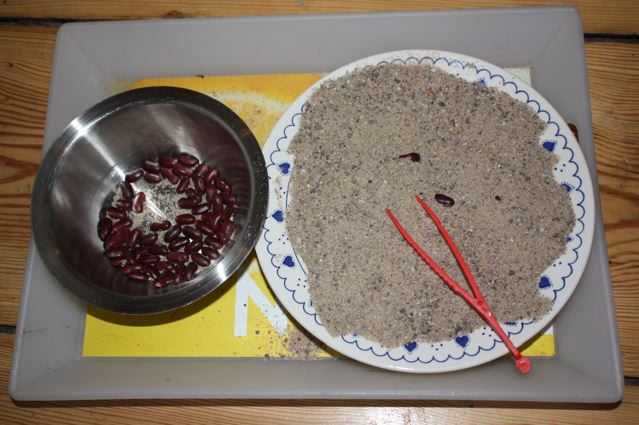
This week I offered another option which was a hit.  (It, too, was inspired by Nataša in Croatia!)  One classic Montessori exercise to develop fine motor skills and the ability to classify and categorize is to have the children transfer objects with a tweezer from one place to another.  Here to go along with the theme of planting, I placed dried beans in a bowl of sand and had the children fish them out with tweezers and transfer them to another bowl.  


Update 2012: Please click here to see a later post on the Parable of the Mustard Seed and here to find out about the new materials.