Friday, January 18, 2013

Sharing Dr. MLK Jr. with kids

Dr. King's actual birthday was earlier this week, but the official holiday will be celebrated on Monday. Whether you are American or not, religious or not, the story of Dr. Martin Luther King Jr. is an inspiring one that is worth telling your children. How God can use an ordinary person to bring about extraordinary changes. And if you are an American, your children deserve to know this part of their country's history, because it is part of their historical and spiritual inheritance, regardless of race, creed or religion.


Below are some short, child-friendly videos that I found.


This one is a short cartoon called "MLK - The King and His Dream" for kindergarten and younger elementary-age students:


This one is from National Geographic Kids and shows actual footage of Dr. King's life and times. I can't imbed it, because it is not on You Tube, but it is perfect for older elementary students.

Also this post from Living Montessori Now has tons of great ideas for celebrating the day with your kids.

And here you and your family can listen to Dr. King's "I have a Dream" speech.

I see his Dream in my own children and in the children that I teach  . . . 


Linked to The Magic Onions

Thursday, January 17, 2013

Godly Play Trainers' Training in Holland: Part 1

Hi everyone, if you've been wondering where I have been, I've been super busy getting grades together for the end of the first semester, and finishing up a couple of projects for Godly Play Deutschland. I love to be in this space, but the things happening in real time take priority.: )

One of my favorite blogs is called "What did we do all Day?", and that is an appropriate question about our recent training in Holland to become Godly Play Trainers. Exactly what did we do all day for six days straight? Can you really discuss and do Godly Play from morning until evening for that long?

Well, for the inquiring mind that want to know, you can talk about and practice Godly Play for six days and still not have all of your questions answered.: )  

There were 12 of us training to be Trainers and we were divided into 2 groups of six. Our trainers were Dr. Rebecca Nye, the author of Children's Spirituality: What it is and Why it Matters, and the Rev. Peter Privett, who together brought Godly Play to Europe in the late 1990s. They were both wonderful down-to-earth people who came in with the attitude that we were all learning together rather than them being the experts who knew everything. How refreshing that was! 

Our training was divided into three parts:

1) Training another Storyteller 

2) Telling a story and being trained by another Storyteller

3) Background work in Children's Spirituality

Since I promised to write shorter posts, I'll just tell you about the first part today: 

Training a fellow Storyteller

This was baptism by fire for me, because I was the very first one in my group train someone else! Fortunately, Rebecca and Peter had brought along Peter's wife, Rosemary (brave woman!), to be a guinea pig storyteller, and Rebecca had begun the training by training Rosemary.  I trained Andrea from England who did a marvelous job of telling "The Flood and the Ark". Fortunately, I had told my kids this story in Nov., so I was familiar with it. 
       
When you train someone else, you sit outside of the circle behind the group in a chair, so that you have a clear view of what is going on and take notes as quietly as possible about what you see. Then, you observe the story, the Storyteller, the people listening, and the Wondering at the end. 

I found it incredibly difficult to be such a multitasked here! My natural Modus Operandi is to get drawn into the story itself and forget about everything else. I had to fight with myself to stay on track and keep observing. Taking notes helped a lot. 

When the story was finished, I had to gently find a way to enter the group. The circle had been formed in the beginning and the participants had experienced a deep Wondering time together. To come in too abruptly would have made everything suddenly strange and possibly make the Storyteller nervous about what I was going to say. So following Rebecca's example as a Trainer, I gently asked if I could join the group. 

Andrea had done a brilliant job of telling the story, so there wasn't much to address in the first place. I began by asking her how the experience had been for her. After she shared, I asked the group what they liked about the story, and they shared encouragements for quite a while. Finally, I asked Andrea, "Were there any rough spots for you?" Then, she knew exactly what had been problematic without me even having to mention it. 

I discovered through all of this that being a Trainer is really a pastoral role. You are not necessarily there to give a lot of direct critique, but to help the person draw it out for themselves. You want to encourage the storyteller that he or she can do this storytelling thing. Rebecca and Peter stressed that training someone is different every time and that you just have to look for teachable moments and feel the person out for how open they are for critique. Apparently, in most Core Trainings, the time for the direct instruction is during the practice time, BEFORE the person tells the story in front of the group. The training afterwards is a debrief about how it went. 

Also, one important thing that I mentioned in my first post on the training, is that a Trainer evaluates not just the story, but the session as a whole. Again, this stretched my multi-tasking skills, but I think it will get easier with practice.

Right after my experience as a Trainer, Rebecca then debriefed me by doing exactly the same sort of thing that I had just done with Andrea. And then I thought to myself, I think I can really do this!


Tuesday, January 8, 2013

The Elements of a Godly Play Session

You may be wondering why you haven't yet heard anything about the Godly Play Trainers' Training that I attended in Holland. The truth is that as soon as I returned home, I was hit with the news about the tragedy in Newtown, CT, and it didn't seem appropriate to be rejoicing about something when there was so much pain elsewhere in the world. Also, my daughter's 7th birthday was on the same day that I returned, and then we jumped straight into the last week of Advent and Christmas. So it's only now that I have begun to reflect on all that I learned and experienced in Holland. 

What a wonderful and overwhelming experience it was! Though I am now officially a Godly Play Trainer, I know that this is a role that I will have to grow into over time.

I'd like to begin by giving you some bite-size chunks of what we learned rather than overwhelming you with long posts. 

One significant thing that Rebecca and Peter, our trainers, brought out in the beginning was the need to train people to do all the elements of a Godly Play session and not just focus on the story. I must admit that when I thought about training others myself, most often my thoughts were about the story or the response time. But all of the elements are important. 

Here is a visual aid that Rebecca shared to help us see the whole picture:


(Idea courtesy of Alison Seaman, Godly Play Trainer, UK)
The six groups of objects in the picture above represent:

1. The Threshold - This is a literal and metaphorical one. It refers to how the children (or whatever age the Godly Play participants may be) enter the room. Children, in particular, need to a chance to start getting ready before they enter the room. They also need to feel welcomed and know that this is a safe place to express their thoughts. Here, the Co-Teacher can make all the difference. 

2. Building the circle - After the Co-Teacher welcomes each child and he/she crosses the threshold one-by-one, the child selects a place in the circle and the Storyteller greets him/her as well. It is a basic human instinct to want to belong to and feel comfortable in a group, and here the Storyteller can playfully help in this process. 

3. The Story - A story is shared from one of three genres: Sacred Stories, Parables and Liturgical stories. There is one more genre called the "genre of silence". You can read more about these genres here and here.

4. The Wondering - In this part, the group responds to the story they have just heard, both in verbal and non-verbal ways. You can read more about Wondering here. 

5. The Creative Response - Here the children respond individually, but not necessarily to the story they have just heard, but to any story or any other thoughts they may have. You can read more about this here. 

6. The Feast - This part is about community. It is also an indirect preparation for taking communion. 

There are, of course, times when we have to leave out one element or another. For example, sometimes we don't have enough time for the response time, and sometimes we may even leave out the story. But knowing that all of these elements work together and working to make them better makes our Godly Play times much more effective. 

Elements like crossing the threshold and building the circle are never left out. And they become even more important if you are doing Godly Play in a more informal setting such as your home, because the children often have a greater need to get ready.  


I'll be back in the next couple of days with more to share!


Sunday, January 6, 2013

Godly Play: Epiphany + Link-Up

Epiphany has become a special day for me. I didn't grow up celebrating it, and actually didn't know what it was until I was an adult. It is a wonderful way to bring closure to the 12 Days of Christmas (although many churches celebrate one week longer, see Catholic Icing's post on this), and celebrate the revelation of Jesus as the Messiah to the whole world.


Materials from the Godly Play Epiphany story
The word "Epiphany" comes from the Greek and means "manifestation" or "appearance". While Eastern churches focus on the baptism of Jesus at Epiphany, Western churches bring attention to the visit of the Magi to child Jesus. Both stories point to God's physical manifestation in Jesus, but in the Magi story we also remember that Jesus was revealed to the Gentiles as well.

Our project did not hold services this week, so I planned a special family service for our kids. Early this morning, the kids and I got up to bake a "La Galette des Rois", a French King's Cake made of puff pastry and filled with frangipane. We used this easy recipe here and added vanilla and lemon zest to it.


Before baking . . . We used a cookie cutter
to make a star in the center.
A "bean" or small figure is traditionally placed inside the cake and whoever gets that piece is "king" for a day. (The Louisiana Mardi Gras cake developed from this tradition.) We placed a plastic Wise Man inside ours. Since it was made of plastic, I wrapped it in tin foil to hopefully avoid any toxins leaking into the cake!


Brushing egg yolk onto the puff pastry.

A golden brown delight!
Later that morning, I told the Godly Play Epiphany story during our family service. This story recaps the journey to Bethlehem in the Advent story and then focuses attention on the three gifts that the Magi brought. Since I was not able to acquire frankincense and myrrh this year, I printed out pictures on the internet and pasted them on gold card stock so that the children could actually see what they look like. (You can the images them here: gold, frankincense and myrrh.)


The whole story laid out.
Cards for gold, frankincense,
and myrrh.
This story does not have any official Wondering, but I felt that my children needed something to help them ponder the gifts more. So I added the following questions:


I wonder which gift is your favorite?

I wonder which gift you think is the most important?

What gift would you give to the child Jesus?

This turned out to be one of the most fun Wondering times that I have ever had with my own kids. Between the second and third question, one of the kids wondered aloud what the gifts might have been for. My son thought that there might be some connection between three gifts and the three members of the Trinity. He went on to say that gold could be for the Father, because gold is a gift for kings; that myrrh could be for Jesus, since it was used for funerals and Jesus would die someday; and that frankincense was like the Holy Spirit, because it was used in worship and released a smell that was unseen. I think he might have been drawing a connection there with the Baptism story, because in it we speak of the Holy  Spirit as being "invisible like the scent of oil". 

My daughter, who usually does more silent wondering when it's just the four of us, was quite talkative today. She wondered aloud about the myrrh and went to the bookshelf, where she pulled out a book with the story of Jesus being anointed by the woman in Simon's house. She pointed to the nard and wanted to know if it was like myrrh. Also, when asked what she would give the child Jesus as a present, she said, "I would draw him a picture of me, so that he could see me all the time.": )

And then we came the Feast, which everyone was particularly excited about because of the King Cake. I reminded the kids of the tradition that the person who finds the plastic king in their cake is King for a day. I was met with replies like, "Yeah, I want to get it so I can order Dad around!" I suggested that maybe we should think about being a king like Jesus was king and that started some more wondering. As it turns out, no one got a piece with the king in it, so we'll have to wait until tomorrow (when we have room for some more cake) to see who will be King for a day . . . 


One piece is enough as this cake is quite filling!
Linked to Montessori Monday at Living Montessori Now

and Eco-Kids Tuesdays at Like Mama-Like Daughter and Organic Aspirations

and Waldorf Wednesday at Seasons of Joy


And now for last Exploring Christmas Link-Up! I have thoroughly enjoyed reading all of your wonderful ideas. If you are joining us for the first time today, maybe you will find some ideas for next year.

If you participate, please link back to Explore and Express. Feel free to grab the button below or in the side bar. 


By participating in the link party, you give me permission to share your photos in future highlights.

Please do not link giveaways or advertisements for commercial items. Thanks!

Friday, January 4, 2013

Creative Christmastide Prayer with Children

I want to share an idea for children's prayer that I saw recently. After Christmas, we happened to pop into the Zionskirche, the church where Dietrich Bonhoeffer taught confirmation classes, while taking a walk. Near the altar, they had the following set-up for spontaneous prayer. My children were immediately drawn to it and so was another child who happened to be in the building. 


There was a nativity scene with a basket full of tea lights and a candlelighter nearby. The children were encouraged to light a candle, say a prayer, and then set the candle among the nativity landscape. This is especially meaningful if the children have spent time on passages like Isaiah 9:2 ("The people who walk in darkness have seen a great light") during Advent. 


The second part of the prayer set-up involved placing a written or drawn prayer in the holes of cinder blocks. My daughter, who can't yet write, drew a picture. 


This type of prayer is great for both younger and older children, because it allows them to express themselves verbally or non-verbally, depending on where the child is developmentally. It also particularly appeals to children who tend towards the spiritual style of symbolism.


I would definitely like to do something 
like this next year! 

Wednesday, January 2, 2013

Group Art Project: Life-Size Fairy Collage

My daughter's birthday is in December in the middle of Advent. Despite being so close to Christmas, she has never seen this as a disadvantage and loves that a celebration is going on the whole month. Though I try to work with the natural seasons and rhythms in almost every aspect of our lives, I make exceptions with her birthday. So if she wants a fairy-garden-themed party in the middle of December, then why not? Which was the inspiration for this group art project . . .

a life-size fairy collage!


Group or collaborative art projects are one aspect of art education that fascinates me. It is also one of the least-written about topics on the internet. (That's probably why my first post on collaborative projects is one of my most popular.) Probably because there aren't as many art teachers out there doing them. It takes time and effort to think them up and pull them off. But the pedagogical benefits for the children are more than worth it!


The original idea for this project came from a website about fairy-themed birthday parties that you can find here. I then adapted the project for our needs and art supplies that I already had on hand.

Here's what to do:

Materials:
roll of butcher paper (or some other large format art paper)
paints
paintbrushes
water dishes for rinsing
sponges for blotting brushes
jewels, feathers, buttons or other interesting objects to use for collage pieces
glue

1. Roll out the paper and trace the outline of your child's body.

2. Have the children brainstorm what they can add to the picture to transform the the outline into a fairy (i.e. wings, crown, wand, etc.), or what they could paint as a background.

3. Provide the children with paints, sponges and rinsing dishes, and ask them to paint the fairy.

4. After the paint has dried, give them the collage pieces and glue.


And now for the pedagogical benefits . . . 

Group projects like this allow children to be in situations where they must work as a team. They have to agree on ideas and delegate who will paint or glue what. They have to communicate, problem-solve, and make compromises - all skills that children must learn to make it in the real world.

Watching this process again at my daughter's party was beautiful. The birthday girl had very specific ideas of what she wanted, but had to make compromises. There was also one big "mistake" where some paint dripped where the girls had to figure out how to make it look nice again. (I'm sure you can hear me quoting Mona Brookes at this point, "There are no mistakes in art - only changes to be made.") The idea to paint a background came about spontaneously, because a couple of girls didn't have anything to do. 

If your child isn't into fairies, you could easily do the same project with another theme (knight, sports figure, profession, etc.) For a children's worship service, the kids could paint a biblical figure as well.

Do you have any experience with group art projects? If so, I'd love to hear about them!


Tuesday, January 1, 2013

New Year's in Berlin

New's Year's Eve in Berlin is a crazy, wonderful time. And this is why . . . 


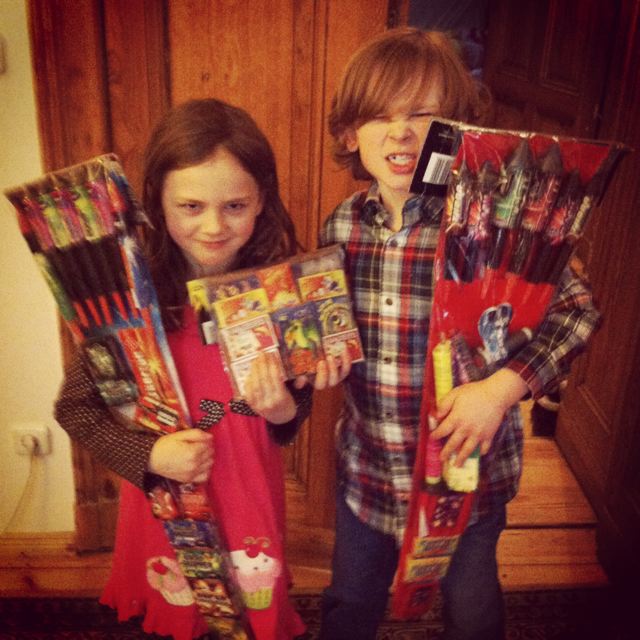
Fireworks! 

Right after Christmas, you start hearing them go off at all hours of the day and night, and the excitement continues to build until New Year's Eve. Then, at midnight on New Year's Eve, the entire city looks like a war zone with fireworks going off literally everywhere. Normally cautious, security-conscious Germans suddenly forget where they left their heads, and you definitely want to be where you are going to spend the night by midnight when the sky is lit up for at least an hour!

Our iPhone pictures can't do the fireworks justice, but you can
see the haze from all of the smoke!

My son with a giant sparkler.
We celebrate New Year's each year with our children's godparents, who are two of our best friends, and their children. The four kids all have a blast helping to shoot off fireworks, playing and staying up late.

Food is always a special part of our celebration. Each year we have either fondue (which we ate this year!) or raclette. When we have fondue, we enjoy a 3 course meal over several hours: a cheese course, one chicken and vegetables in broth, and then a chocolate and fruit course. 


Raclette is also a Swiss tradition, similar to fondue, where meat and veggies are roasted on a tabletop grill. Both types of meals are interactive and community-building, so it makes for quite a fun evening!

Source: Raclette Australia

Then, on New Year's Day, we eat brunch together and then try to pick ourselves up and go home after staying up so late. Later in the day at home, my husband, a native Texan, makes us a pot of super-spicy chili. Yum, yum!

Hope that your New Year's celebration was wonderful, and I wish you the joy and peace of Christ in 2013!