Thursday, October 18, 2012

Children and Existential Limits

Jerome Berryman, the creator of Godly Play, writes about four existential limits that both children and adults are confronted with: death, the threat of freedom, the need for meaning and fundamental aloneness. We as human beings are confronted with these things at an early age, and how we learn to cope with them shapes both our character, worldview and ability to make wise decisions. When spiritually mentoring children, we allow children to be confronted with these limits through the Biblical narrative and invite God to be a part of the dialogue. How he initiates and engages with the children (and we teachers as co-learners!) is an exciting process. 

Many adults are afraid to talk with children about death. However, children are confronted with the concept of death often, be it from the falling leaves in autumn to the passing away of a beloved pet. And if they don't have the opportunity to work out for themselves how to respond to this limit set to our humanity, then the child is completely unprepared when something much more heart-breaking occurs, like the death of a grandparent.

Often we adults also fail to consider that children struggle as well with aloneness (despite being part of a community) and finding meaning and purpose in our lives. We think that only adolescents grapple with these issues. Children most definitely deal with them, but express much of their thoughts non-verbally. This is due to their language development, which has yet to reach a level that allows them to share more of their thoughts with words.

Young children share their thoughts more easily
in non-verbal ways.
This is where the "play" in Godly Play comes in. Children learn best while playing. (If you ever tried to teach a child math or a foreign language, you know they respond a lot better to a game than to a worksheet!) When children play "house" or Star Wars, they work out possibilities. They do the same when playing with God.

This type of play can make the adults in the room nervous, because they project their own life experience onto the child's play. Sometimes it can sound sacrilegious to the adults, even when it is not. Recently, we told the baptism story to our Sunday Godly Play group. This story involves baptizing a doll in order to show the children what actually happens during a baptism. During the response time afterwards, a little boy took out the materials and began "baptizing" the doll. He then immersed the doll in the water and pretended that it was swimming. Then, he began to pretend that  the doll was drowning.

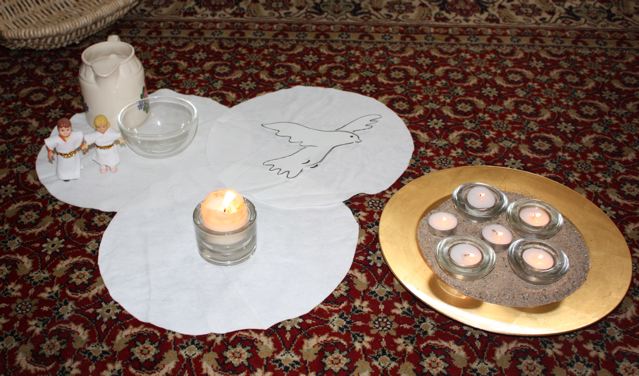
Materials for the Godly Play story, "Holy Baptism".
I think at that point, many children's workers would have rushed to intervene, thinking that either the boy was being too wild in his play or poking fun at a sacred rite. (Fortunately, my co-teacher is not phased by things like that, although she does get a little nervous when they light the candles!)  I knew that this child had been talking about baptism  for a while and was even thinking about being baptized in one of Berlin's lakes in the summer. Most likely he was working out what it would be like to be baptized by full-immersion. Could you drown while being baptized in a lake? Would it be okay to go swimming afterwards? Important things for a child to consider. I looked over as he was happily playing and said, "I'd sure like to swim in God's love", something that I have meditated on this week (a week that has been difficult and most certainly has not gone according to my plan!)

Learning to recognize when the children and God are working these matters out in a playful manner takes time and patience. It requires one to listen more than talk or instruct. But it is essential for both the children and us.


Linked to Montessori Monday at Living Montessori Now

Saturday, October 13, 2012

Two Flat Tires and a Blessing in Disguise

(aka Another Irish Adventure!)

Today I'll write about the part of our trip that didn't go quite according to plan. We set out for the Ring of Kerry, an off-the-beaten-path road with beautiful scenery, in an Avis rental car. It sounded like a good idea, but we didn't know that the roads in that area are notorious for their potholes.

Near the town of Macroom we hit a jagged pothole and blew out a tire. Luckily for us, the next place to turn off the road was into the parking lot of the Coolavokig Pottery shop. After discovering that our rental car was lacking a spare tire and that our German cell phone was not getting service, we knocked on the door of the shop. Robb and Meredith, the super-hospitable owners, not only helped us call Avis, but invited us to lunch as well.


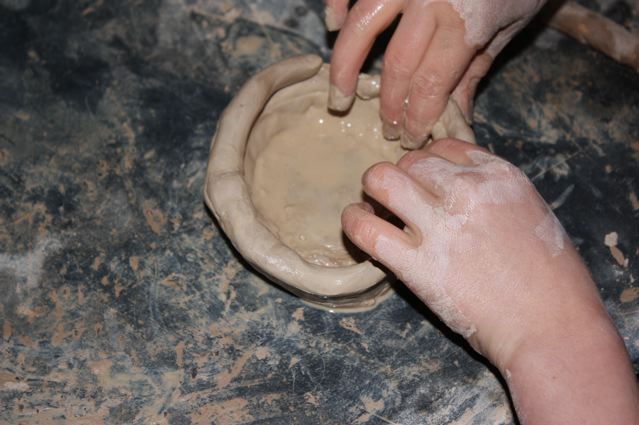
Avis promised to deliver a new rental car, but it would take two hours to get it to us. To pass the time, Meredith showed us around their garden and her pottery studio. My children, who can sniff out an art adventure like bloodhounds, seized the moment and began making pottery themselves as Meredith patiently showed them what to do.

Meredith in her studio.


At the end of the day, both kids agreed that this had been the best part of the day. A blessing in disguise. We had made new friends, enjoyed local hospitality, and made some art as well. I also became the proud owner of some gorgeous new pottery pieces. If you are ever near Macroom, please visit Meredith and Robb's  shop!


Avis finally delivered the new car, a mini-van, and we continued on the long and winding road, stopping here and there to see more breathtaking scenery . . .


when lo and behold, we hit another pothole and discovered that we had a second flat tire! Neither the luck of the Irish nor Irish eyes were smiling on us. This time, there was a spare tire in the van, but the wrong tools to change the tire!

Second flat tire: waiting for help to arrive.

After flagging down a local man who knew a mechanic, we were able to change the tire and made our way further around the Ring. This time there was no apparent blessing in disguise, except that the kids had a chance to eat their lollipops that I had forbidden them to eat in the car.: )

Our next stop was Staigue Fort, a pre-Christian circular fort, remarkable for the fact that it it built entirely without mortar. The fort was worth seeing, but the way to it required a rather long drive on a one-lane road with traffic going in both directions. After two flat tires, I was a little weary of bad roads and almost had heart failure a couple of times before we got back on the main road.


Well, we survived the Ring of Kerry with no further unpleasantries and made our way up to the cliffs of Moher near Doolin. The Cliffs really do take you take your breath away and no picture could ever do them justice. They are also famous as the Cliffs of Despair in the "Princess Bride" film.


We were also treated to a music festival with local musicians and dancers at a pub. And our kids made friends with a horse named Madam.


Now we are back home drinking coffee from our new pottery and reading Irish fairy tales.


And now I also promise to get back to the relevant topics of this blog . . . !

Friday, October 12, 2012

Irish Adventure: Blarney Castle

"Cormac MacCarthy,
Bold as bricks,
Made me
In Fourteen Forty-six."


And ol' Cormac built to impress. Visiting Blarney Castle was like diving head-first into a fairy tale. The ancient monolithic structure protruding from velvet green grass made our imaginations run wild.

A time-honored tradition is to kiss the Blarney Stone. Supposedly one of the 99 things to do before you die, we couldn't resist trying it. Kissing it is supposed to bring one eloquence. (We'll see if it helps my blog posts!) You can see in the picture below that you have to lay down and lean over backwards over a castle wall with your head way back in order to reach it. A fairly wild experience if you are at all scared of heights. These days, there are rails to block your fall and a nice castle employee to hold onto you, but apparently it used to be something that people risked their life to do. (There's even a Sherlock Holmes story about a man falling to his death in an attempt to kiss the stone.) Even so, my husband had a tight grip on my son's legs just in case.: ) I wasn't so much of heights as of the germs that might have been lurking around following the hundreds of visitors who came before me that day. My 6-year-old daughter was a little too frightened to try, but then again she doesn't need the gift of gab since her nickname is "Motor Mouth".

My son kissing the Blarney Stone. 
While the castle itself is impressive, the real stars of the show at Blarney are the centuries-old trees and boulders found everywhere on the grounds. At home we've been reading The Hobbit of late, and we were all convinced that Tolkien must had this place in mind as he was writing. The kids half-expected to see an elf or fairy pop out from behind a tree at any moment.: )


Having our grandparents with us made the experience all the sweeter.


There is also a cave that leads to the dungeon. Definitely not meant for full-grown adults in the 21st century, I had to turn back because of claustrophobia. My kids went on until it turned pitch-black.: )


If you are looking for a fairy tale, Ireland is the place to find it!

Thursday, October 11, 2012

The Colors of Ireland

As you may have guessed from my last post, we just returned from a family vacation to Ireland. While I had always heard that the Emerald Isle was breathtaking, I was still amazed by the vibrant colors that I encountered.

Even in mid-October the ground was covered by a luscious carpet of green.


Fiery wildflowers . . . 


and verdant ferns evoke an untamed antiquity.


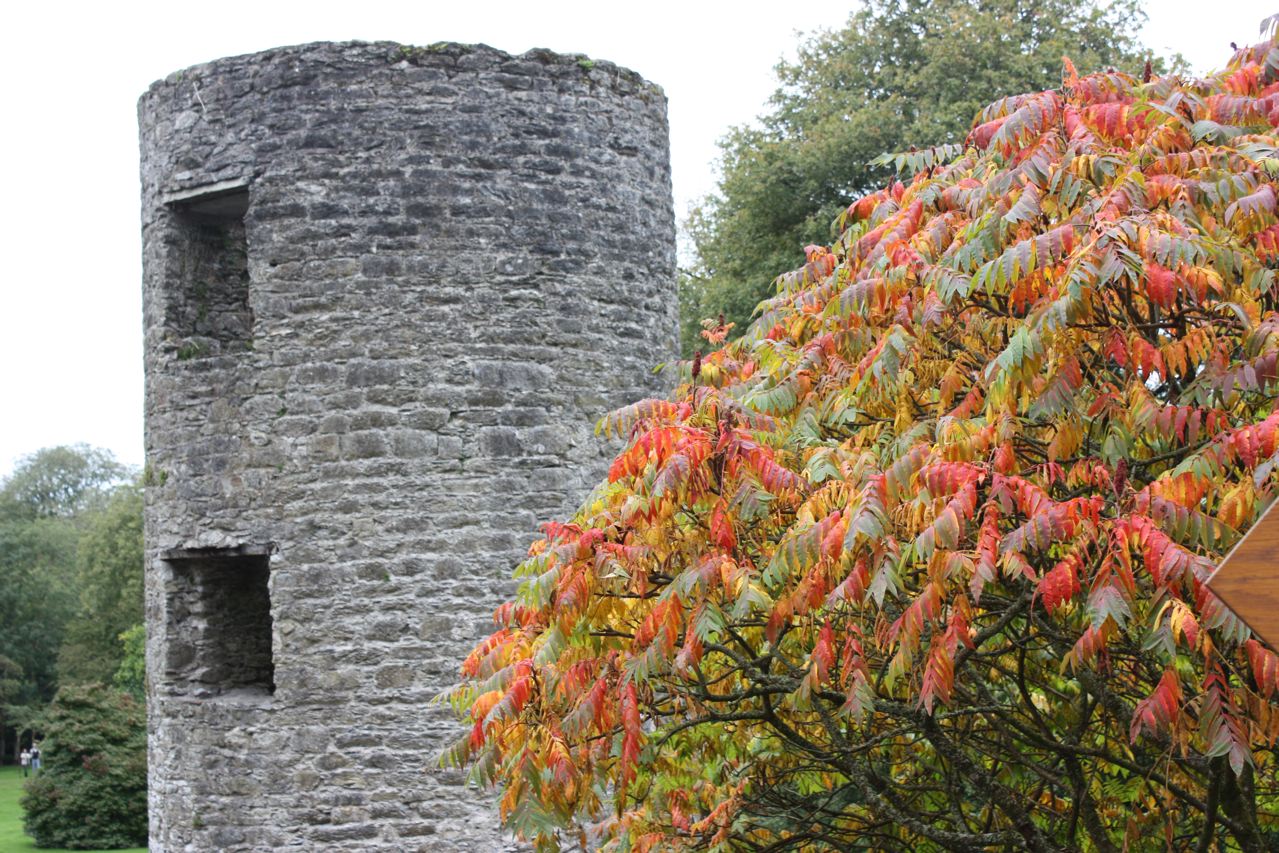
Orange and red leaves signal autumn.


Smooth, white stone against clear, blue skies . . . 


and ancient white stone walls mark the passing of time. 


Warm sunset hues along the Ring of Kerry.


The Cliffs of Moher are shrouded in rich green grass and moss. 


Ireland is a sensory delight!


Linked to Friday's Nature Table at The Magic Onions


and Naturkinder


Wednesday, October 10, 2012

Fun with the Book of Kells

(or how to prepare your children to see great works of art!)

When I found out that we were going to visit Ireland during our fall break from school, I knew that I wanted to see the Book of Kells, the most famous of the illuminated manuscripts hand-drawn by Irish monks during the Middle Ages. (I left it to my husband, the best trip-planner ever, to figure out the logistics of getting us there!) In fact, I'd been waiting over twenty years to see this masterpiece and could hardly contain myself at the thought of seeing it in person.

The Chi-Rho page from the Book of Kells. It actually marks the beginning of the
Christmas story in Matthew's Gospel.
Source: Art & Culture
Naturally, I wanted to pass on this excitement to my son and daughter, who are ages 9 and 6 respectively. One thing that I have learned through the years is that children tend to appreciate famous works of art in a museum setting if they know something about what they are going to see beforehand. So, in preparing to see the Book of Kells, we pulled out Sister Wendy Beckett's Story of Painting to see what she had to say about it. (Sister Wendy was my first art teacher and I am indebted to her for most of what I know about art in Western civilization!) There, we examined the Chi-Rho page pictured above and found out that the playful monks had hidden butterflies, cats and mice, angels and an otter with a fish in his mouth with in the beautiful illuminated letters.

Well, as soon as these strange-looking Greek letters turned into a picture search game, the kids got excited. My son was the first to find the butterflies and the cats. We searched forever to find the otter, but finally had to give up. When we got to see the real thing at Trinity College in Dublin, we finally found the otter with the fish in his mouth and there was much rejoicing! The preparation made the Book of Kells Exhibit, which is definitely not geared toward children, meaningful for both kids.

Photography is not allowed inside the exhibit,
so this is the only proof I have that we were there!
We had a similar experience when we visited the National Gallery in London, England this summer. We had been reading the Katie series by James Mayhew that I have mentioned before here. These are books about a little girl who visits museums with her grandmother. The grandmother always manages to fall asleep and Katie is able to crawl inside the paintings and make friends with the people in them. As we entered the first hall of the National Gallery, the kids ran up to a painting of a man and started yelling, "Look Mommy! It's Princess Margarita's father!" As I took a closer look, the painting was indeed Philip IV of Spain in Brown and Silver by Velaquez, which is featured in Katie and the Spanish Princess.

As we went room to room, they recognized other works by Murillo, Seurat, Renoir, and Degas without our help. All because they had a context and emotional attachment to the paintings through the Katie series.

So here are my tips for preparing your kids to enjoy great works of art:

1. Show them a picture of what you are going to see and talk about it. Tell them why you like it and what you think is interesting about it. Ask your child what he or she sees in the work of art.

2. Read a children's book about the artist or work of art. There are so many fantastic children's books about art these days, that it shouldn't be hard to find the right one. Just make a trip to the public library. Even if you can't find a children's book, a normal art book like Sister Wendy's can be helpful.

3. Make a game of it. Play "I Spy" with the things within the picture. Or xerox a copy and cut it into a puzzle that the kids can put together. If you are going to a larger museum with multiple works of art, make a small Memory game by gluing pairs of works to index cards.

If you have other ways to help children make the most of museum visits, please let us know about it in the comments!


Linked to Waldorf  Wednesday at Seasons of Joy

Wednesday, October 3, 2012

Art Project: Desert Treasure Boxes

In preparing for our "Expedition in the Desert!", I came up with this idea so that the children would have an open-ended project to help them go deeper with the stories they hear. If you are doing a desert theme with your children at church or at school, it is a fun way to help them contemplate more.


The first step is to give the children small, plain craft boxes to decorate. I ordered mine here.


Then have the children decorate the boxes however they like. (I specifically did not decorate one beforehand to show the children, so that they would not simply copy mine!) I provided them with both paint and colored construction paper.


This child covered his box in construction
paper and made a latch for it.
The next step is to put a small amount of sand in the box.


Then, we gave the children air-drying clay (I use this brand) and asked them to make a small "treasure" to go inside the box. I suggested that they make something that either reminded them of a desert story or of their friendship with God.


The children made a variety of things: camels, crosses, a challis, a spiral. 


Below you can see my set-up for this particular project. I placed paint, brushes, water, glue, scissors, colored paper, sand and clay in an orderly manner on the table. I like to place things like scissors and glue in trays to keep them from getting scattered everywhere.


If you try this project with your own students, please let me know.  I'd love to hear about how it went and see pictures!


Linked to Friday's Nature Table at The Magic Onions