Thursday, June 16, 2011

Art Project inspired by Rublev's "Holy Trinity"

Andrei Rublev's icon, "The Holy Trinity"
While living in Russia in the early 90's, I fell in love with Andrei Rublev's famous icon, "The Holy Trinity".  This icon dating from around 1410 depicts the three visitors that appeared to Abraham near Mamre in Genesis 18.  While there is debate among theologians as to whether the three visitors were actually the Trinity, the story provides the basis for a beautiful symbolic portrait of the Father, Son and Holy Spirit. Each of the three members of the Trinity are seated in a circle representing their unity and perfect love and respect for one other. And each one is either holding something or has a something symbolic behind him that points to his divine character. Even the choice of  colors for their clothing stands for their divine attributes.

During the Pentecost season last year, we did a lesson on the Trinity.  Explaining the Trinity to anyone, let alone a child, is an almost impossible task! (It is, of course, a mystery of faith that both baffles and irresistably intrigues us.)  We used classic illustrations such as water in its three forms and an egg (shell, yolk, white) to give the children a visual idea of how something can be the same, but take different forms.  We then showed the children Rublev's icon using this wonderful page from Wellspring.  Wellspring offers a virtual tour of the icon by allowing one to click on each member of the Trinity for an explanation of the colors, attire and imagery used for each figure. As a general rule, I never use computers or media in children's worship, but this was too good to pass up. : )

As an opportunity to creatively respond to what they had heard about the Trinity, I created this watercolor project for the children:


Step 1:  Use a pattern to trace the basic outline of the Father, Son and Holy Spirit with their halos. You may download my pattern here. Please note that my pattern gives the basic outline of the three figures with their halos, but not angelic wings so that the children can draw these themselves if they wish. 


Step 2:  Have the children pencil in any facial features that they want to add to the three figures of the Trinity as well as the angelic wings. They can also draw bread and wine on the table in the middle of the three figures. I left my faces blank, but the children last year chose to draw facial pictures and they were marvelous!


Step 3: Have the children brainstorm different images that remind them of each member of the Trinity and pencil these in behind each figure just as Rublev did in the original icon.  For my sample, I chose the sun to represent the Father, a tree for the Son, and a waterfall for the Holy Spirit.  But the children could choose anything they want. 


Step 4:  Paint each area with watercolor.  Adding salt to the wet watercolor in the halos produces a nice effect.  

A close-up of the halos after salt was sprinkled on the wet paint.

Step 5:  This is optional, but tracing the completed figures with black marker or black pastel can give the painting a more completed look.  

The children who participated in this project were ages 3-5. While this may seem like a project for older children (and well it could be), the goal with younger children is not technical excellence. Rather the goal is to give the children an opportunity to think about and explore what each member of the Trinity is like. 

I so wish that I had picture of my children's paintings from last year to show you!  They were made before I started blogging and the kids' finished paintings were so good that their grandmother took them to the States with her.: )


Tuesday, June 14, 2011

Montessori Musings: Learning to Read

I have bilingual children and one long-term educational goal for them is to be able to function in both English-speaking and German-speaking worlds. My son attends a German public school and my daughter is in a private parent-run kindergarten (meaning that we parents do the admin stuff and handiwork, but not the actual teaching).  While I do not homeschool, I put a lot of effort into "after-schooling", because of the bilingual aspect.

When my son was still very young, I was advised by several people including a linguist (who also happened to be the parent of trilingual children) to teach my children to read the most difficult language first.  While German grammar is definitely more difficult than English grammar, German is a phonetic language and quite easy to read.  English, on the other hand, is not phonetic and filled with exceptions to rules.

I successfully taught my son to read using a textbook called Teach your Child to Read in 100 Easy Lessons.  It was a great tool for my son and he enjoyed the progression of the book.  At age seven, he is now reading beyond his grade level in English, even though the rest of his education is entirely in German.

Then, after my daughter started showing all the indications that she was ready to learn to read, I began attempting to teach her with the same book.  As any mother of more than one child will tell you, each one is different.: ) It didn't take long to figure out that the book was not going to work with her!  It was absolute torture for her and she needed something much more tactile to motivate her.

Fortunately for her (and me!), the year before I had begun to take an interest in the Montessori method through my experience with Godly Play.  Taking Karen Tyler's on-line Montessori Training has put some practicals tools in my hand to give her a much more holistic way of learning.  (It has also helped me in teaching English at our local elementary school.)

Below is a photo of one of our recent lessons where she is learning to match sounds with letters.  She is in the Pink Series, the first level of Montessori reading. Here she is matching the beginning sound in the picture cards (free downloads from Montessori for Everyone and Montessori Materials ) with letter cards.  Then, she draws the letter itself in a tray filled with a thin layer of cornmeal. (I have yet to find a child that can resist playing with cornmeal!)


In the Montessori method, subjects and skills overlap so that the child can learn several things in one activity. Here she is working on phonetics, writing and sorting/classifying (a math skill) all in one lesson. 

One thing that I have learned from Karen is how to "improvise" with materials so that I am not spending exorbitant amounts on pricy materials.  Sandpaper letters are a basic in Montessori reading and writing, but I chose to spend the money on other things and make textured letter cards myself.  The letter cards that you see in the picture are textured letter stickers made from corrugated cardboard that I have attached to index cards. I spent the money saved on sandpaper cursive letters which I hope will serve her well in the future.

This is my daughter's "surprise box". She picks a letter and I fill the
box with objects that begin with that letter.  Here you can also see my alternative to the sandpaper letters a little better.


So far, we are doing well and and enjoying learning.  I'll let you know how things progress!

Linked to Montessori Monday at One Hook Wonder.

Sunday, June 12, 2011

Pentecost (Whitsun)/Pfingsten

Today we celebrated Pentecost (also called "Whitsun") at Family Brunch. On this special day, the church celebrates two things:  1) God's gift of the Holy Spirit to all believers and 2) the birthday of the worldwide church.  Our children at Haus Berlin e.V. heard two stories from Young Children and Worship that I combined for this special occasion.

The first story, entitled "Pentecost" Sonja Stewart's book, follows the account in Acts 2 of the first followers of Jesus who gathered in the upper room waiting for God's gift of the Holy Spirit just as Jesus had asked of them.  This YWC story does a great job of explaining what happened, but also leaving things to the children's imagination.  After all, how exactly does one explain a rushing wind filling the room and tongues of fire appearing over people's heads?  Rather than using visual objects to tell those parts of the story, the storyteller uses specific hand motions that are faithful to the text, but also leave the children to visualize with their own imaginations.  (I feel this is very important, because the Biblical text was written by a first century author and it is difficult for us as 21st century readers to know exactly what St. Luke was describing.) And rather than emphasizing the supernatural events, the story places emphasis on the effects that this filling of the Spirit had on the followers of Jesus:  joyous love for God and other people.

As you can see here, I had a hard time getting the figures to stand up on the uneven ground.
Perhaps I need to use the art boards underneath the felt next time.: )
The second story that I told was from Stewart's second volume of stories, Following Jesus, and is called "God's Gift of the Holy Spirit". In Stewart's original story, she lists seven gifts that followers of Jesus receive and bases them on texts from Isaiah 11 and Acts 1. Because I come from a slightly different theological background than she does, I found it a bit of a stretch to say that these seven gifts were what the original believers received.  I was much more comfortable with using St. Paul's list of nine spiritual gifts listed in 1 Corinthians 12.  Although I would not say that Dr. Stewart is wrong in her understanding of the seven gifts in her original story, the original text about Pentecost only infers, but does not directly state what those gifts were. Therefore, it makes more sense to me to base the story on a text that is clearer on the subject. 

"God's Gift of the Holy Spirit" materials
We had a free response time for the creative phase today. Below you can see my set-up of materials laid out in a row on trays for the children to choose from.  They had two different types of paper, paint, crayons, and oil pastels, paintbrushes, bowls for rinsing, and sponges.  I think it is important to vary the paper that the children use.  Otherwise, they get too used to one size and one way of positioning it. Varying the paper reinforces good problem-solving skills and going into new situations with confidence.

Just in case you're wondering, the Sprite bottle
 is filled with water for rinsing brushes. : )

Hard at work.
The girls loved the colored paper.
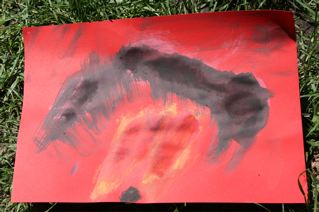
 One little girl was discussing her painting below with me.  She said that the black represented the "storm" (The YCW story describes the rushing wind in the upper room as being like wind in a storm.) and the red and yellow below were the fire. As we talked further, I realized that she had viewed the strong wind as being something negative and scary.  Hmmm . . . I might have to rethink how I describe the wind next time.

A normal part of a Godly Play worship service is the feast time, which is a snack that also prepares children for the idea of taking communion.  We usually don't do this at Family Brunch, because we eat together beforehand, but I decided to try it today.  I set the timer for 15 minutes of creative work and told the children that we would then take a break to pray and eat together, and that they could return to their work afterwards.  The prayer time actually went much better than usual this way.  In the past, I have tried the prayer time right after the story, but it has proved difficult for the children to concentrate that long.


At the very end, we put a birthday candle on our special cupcakes and the girls served them to the adults. They also picked flowers from the park to decorate the plate.


Happy Pentecost to everyone!   Happy Birthday, Church! 
And thank you, Father, for the gift of the Holy Spirit!

Quote of the Day

"There can be no keener revelation of a 
society's soul than the way in which it 
treats its children." 
-Nelson Mandela

Sunday, June 5, 2011

Quote of the Day

"Children are likely to live up to what 
you believe of them."
- Lady Bird Johnson

Saturday, June 4, 2011

Godly Play 101: The Genres

When you are first learning about or trying to implement Godly Play, it can be a bit overwhelming! There seem to be many new things to consider that it helps to break it all into "bite-size" chunks.  That is what I will be attempting to do in the "Godly Play 101" series.

There are three main types or "genres" of Godly Play stories:
  • Sacred Stories ("Glaubensgeschichten" or "Stories of Faith" in German)
  • Parables
  • Liturgical Lessons
Each of these genres has a specific purpose and materials that make them easily recognizable.  

The Sacred Stories, many of which are from the Old Testament, deal with the theme of spiritual identity. In these stories we explore how God meets his creation both as individuals and as a community. We learn to ask questions about how the story of human history is intertwined with the story of God and what our place in this story might be. Also running through these stories is the game of "Hide and Seek" where, according to the Godly Play UK website, "the people of God are called into a relationship that proves to be both revelatory and elusive".

The materials for the Sacred Stories are simple, natural and beautiful. The wooden figures purposefully have no faces, so that the listener can use his/her imagination to fill in the blanks and come to his/her own conclusions. (In Godly Play, less is always more.) Probably the most famous feature of the Sacred Stories is the Desert Box (or Desert Bag) filled with sand used for many of the Old Testament stories.  Godly Play Deutschland has recently come up with an "Erdsack" or "Soil Bag" for stories that do not take place in the desert.  Stones, twigs, wool and other natural materials are used in these stories.

This is our desert bag being used for an Old Testament Sacred Story.
The second genre is the Parables told by Jesus, and these stories are meant to help us ask questions about the Kingdom of God.  What exactly is the Kingdom of God and how do we see and experience it? The style of the Parable genre help children to think creatively and, according to the Godly Play UK site, "see new possibilities".  The parables are also particularly effective with adults. Because many of us grew up with a few specific and limited interpretations of the parables, this genre points out time and again that no matter how many times we have heard the parables, there is always more to learn and consider.  

The striking feature of the material in the Parables is that the figures are two-dimensional.  This is done intentionally to give a storybook feel to them, since they are stories that Jesus told rather than being actual events that took place in history.  Also, the Parables are kept in a wooden, gold box that represents that value, timelessness and mystery of them. My favorite line in the introduction to each parable likens the lid to a door.  "Sometimes you knock and the door opens. But sometimes it remains closed.  I don't know why this is, but don't let it worry you. You can always come back again anytime.  And one day the door will open." (My translation of the German back into English.: ) )

Materials used for the Parable of the Sower
The Liturgical Lessons are the last genre.  These stories deal with the whys behind the rituals and traditions in church.  They help prepare children to take a meaningful part in church services and understand important sacraments such as baptism and communion.  Godly Play came out of the Anglican tradition, so depending on your particular tradition, you may have to tailor  some of the stories to fit your particular setting. 

The materials in the Liturgical lessons are usually three dimensional figures and objects placed on a felt underlay.  For example, in the baptism story, objects representing the Trinity are placed on three white, felt circles, and a doll is "baptized" to visually explain this sacrament.  Below is a lesson about communion that ties in the imagery of the Good Shepherd in Psalm 23 inviting the sheep to his table.


Materials for "The Good Shepherd and the World Communion",
a liturgical lesson about communion.
The Wondering Phase (Ergründungsgespräch) is also different for each of these genres, but I will try to discuss that in another post. 

Fellow Storytellers, please help me out by 
adding to the conversation.: )

Monday, May 30, 2011

Sunday in the Park

The weather in Berlin has warmed up enough that our bi-weekly Family Brunch can meet in the park again.  How wonderful it is to meet with God right in the middle of his wonderful creation!  This week I combined two Young Children and Worship stories, "Jesus Commissions the Disciples" and "Ascension".  Das Wetter in Berlin ist endlich schön geworden und wir dürften den Familien Brunch (ein Angebot von Haus Berlin e.V..) draußen im Park veranstalten. Es war wunderschön Gott mittendrin in seiner Schöpfung zu begegnen! Diese Woche habe ich zwei Geschichten von Young Children in Worship, "Jesus gibt seinen Jüngern einen Auftrag" und "Himmelfahrt", kombiniert. 


The story time was actually a bit rough this week, because the children were so distracted by having church outside for the first time in a long time. But that was okay.  It was exciting to be outside and who wouldn't be distracted by the adorable squirrels and cool bugs?  Das Erzählen von der Geschichte ging ein bisschen schief diese Woche, da die Kinder so  aufgeregt waren den Kindergottesdienst zum ersten Mal draußen nach dem langen Winter zu haben.  Aber das war in Ordnung. Es war einfach toll im Park zu sein und wer hätte sich von den niedlichen Eichhörchen und faszinierenden Insekten nicht ablenken können?


One of the activities that the children could choose from in the Creative Phase was the Ascension Art Project that I wrote about in my last post.  In addition to the artistic aspect, this project involved counting (the children had to make 11 dots for the 11 disciples and 2 white dots for the two angels) and recognition of emotions (I asked the children to imagine how Jesus' friends felt when he left them and if they were happy, sad, surprised, angry, etc.). Während der Kreativphase gab es mehrere Möglichkeiten.  Eins davon war das Kunstprojekt zu Himmelfahrt, die ich im letzen Post gezeigt habe. Zusätzlich zu dem kreativen Aspekt, konnten die Kinder die Zahlen üben, indem sie 11 Püntkchen für die Jünger und 2 für die Engel malen mussten.  Auch habe ich die Kinder gefragt, wie die Jünger sich gefühlt haben als Jesus plötzlich weg war.  Das war eine gute Gelegenheit für die Kinder unterschiedliche Emotionen und Ausdrücke zu überlegen. 

Painting the mountaintop.
Ein Kind malt den Hintergrund.
Drawing the disciple's reactions to
Jesus' ascension with a felt-tipped pen.
Dieses Kind malt die Reaktionen 
der Jünger mit einem Filzstift.

The finished paintings made me smile! Die fertige Bilder haben mich total gefreut!


I set up two Montessori Practical Life activities for the children to choose from as well.  The first one, pictured below, involved stringing buttons in the shape of ladybugs, butterflies, and other insects onto pipe cleaners.  Es gab auch zwei Montessori Angebote vom Bereich, "Praktisches Leben".  Bei der ersten unten sollten die Kinder Knöpfe in der Form von Marienkäfern, Schmetterlingen, und andern Insekten auffädeln.


In the second activity the children used tongs to find and transfer acorn shells from a bowl of sand into the compartments of an ice cube tray. Bei der zweiten Aufgabe sollten die Kinder einen Pinzette benutzen um Eichlen vom Sand in eine Eiswürfelform zu übertragen


The older children who could read had the opportunity to put together the words of the Great Commission.  The control card is in the bottom right hand corner. Die älteren Kinder konnten die letzen Worter, den Auftrag, von Jesus puzzeln. Die Kontrollekarte ist unten rechts.


This was the first time that I have set up a focus table outside.  It looked so beautiful surrounded by the plants in the park.   Ich habe zum ersten Mal einen Fokustisch im Park aufgestellt.  Mit den ganzen Pflanzen herum sah es hübsch aus. 


Have a wonderful Ascension! We get the day off here in Berlin, so we are especially excited! Bis zum nächsten Mal!


Linked to The Magic Onions