Saturday, November 2, 2013

Saturday Shout Outs!

Hi Everyone, Here are a few interesting things from the blogosphere this week that I wanted to pass along: 

from Art of Education
Art Teacher Ian Sands reminds of what sets a great work of art apart from others. I love the Mona Lisa made from coffee cups and the striking Norman Rockwell in this post.


from Rachel Held Evans
Rachel reminds us that "the good ol' days" weren't quite as rosy as some people make them out to be. 


from Patty at Deep Space Sparkle
Patty passes on some inspiring words from dancer Martha Graham. ". . . because there is only one of you in all of time, your expression is unique . . . "

Anything jump out at you this week?  If so, leave a link in the comments, so we can all take a look!


Friday, November 1, 2013

Finishing Up

This has been my year to work on developing my own artistic abilities again. My New Year's resolution was to spend at least 10 minutes a day drawing. That has kind of turned into spending ten minutes a day doing something creative. And it's not happened every day, but it has helped me to carve out time to be creative more often.

I started the painting below in June, but didn't finish it before our whirlwind trip to the States. In the chaos that ensued after we returned, I had to set it aside for a while. Last week, I picked it up again.

Everything was finished except the butterflies. Below, I experimented with a sort of Zentangle design, but wasn't happy with the result. 


So I painted over the Geometric designs with collage paper and paint to make a mosaic type of look. Again, I am not entirely sure that I am happy with the result, but it is finished. It's time to move onto something else!


Thursday, October 31, 2013

Godly Play with Seniors

My family has developed a relationship with a Senior Citizen's Home in our area through our work with Serve the City. On Sunday, I'll be sharing the Parable of the Good Shepherd with the residents as the "sermon" at their church service.

Although I have told GP stories in many settings, this will be my first experience with seniors. Jerome Berryman, the creator of Godly Play, says that his concept is for children from ages "3 to 99", and there are other storytellers who have used it with seniors on a regular basis.

The opportunity arose when I was talking to the Senior Home's ergotherapist about Susan Dyer's blog, The Moveable Alphabet, and how Susan's Montessori work with seniors in Alaska has fascinated me. I also saw a lot of parallels between the work I do with children and the Senior Home's work with their residents. Then, the ergotherapist asked me if I had ever heard of Godly Play . . . !

In planning out the service together, the ergotherapist helped me realize that I would have to adjust a few things for my audience. For one thing, many of the seniors have failing eyesight and my normal wood figures would be too small. So, I decided to photocopy and enlarge them, and then mount them on cardboard.


You can see the difference in the size of my cardboard figure on the left and the normal-sized wooden figure on the right.


I had to make sure they would still fit in the parable box, though!


Then, of course, I had to buy a giant-sized piece of felt for the underlay and then a larger lake, sheep stall and dangerous places. If you're wondering how I'll fit the giant underlay in the parable box, I won't  be able to. Because of the eyesight issues, I'll also be telling the story at a table. 


Another thing is that I will be wearing a lapel mic, since impaired hearing is also an issue with the residents. I'll have to remember not to breathe heavy during pauses in the story!

I'll be very interested to see what the seniors think and how they react to this unusual "sermon"!

Wednesday, October 30, 2013

Learning the story by heart

Last week, I was privileged to lead a Godly Play seminar for 25 teachers from St. Clara Catholic Church's three preschools in Neu-Kölln. We spent some time at the beginning talking about the theology and educational philosophy behind Godly Play. Then, I shared "The Great Family" with  a Response Time. 

Afterwards during a question and answer session, the parish priest asked if I had any tips for learning the texts of the stories. What a great question! I had never given much thought to it before, so his question prompted me to think more about it.

In Godly Play, we encourage the storytellers to learn the texts by heart. For one thing, it would be really difficult to move the figures around the felt or sand if you had to constantly look at a script to know where you are. Also, a very important part of the pedagogy is that the storyteller always has her focus on the materials. If she doesn't, then it breaks the concentration of the whole group. And lastly, the stories "flow" from a deeper emotional level within when we tell them from memory rather than from a piece of paper. 

So how do we learn them, especially the longer texts? I think there are many ways. It certainly helps if you have already read the stories in the Bible and are familiar with them. I tend to read through the entire script out loud once to get the big picture. Then, I learn smaller sections at a time. (Since I tell stories in three different languages, this method really helps me.) Also, the figures themselves provide visual prompts for me, so that I know which part of the text comes next. On the average, I have to practice a new story at least 3 times from start to finish, before I can tell it freely from memory. 

But once I have already told a story, it is much easier to prepare it the next time, even if it is 6 months or a whole year later. And once you've told a story several times, you can "wing it" if you have to. This I also discovered during the Response Time at St. Clara when several of the teachers wanted to hear the Parable of the Sower.: )  

Some of the preschool teachers' work in the Response Time.

What about you? How do you learn the texts for Godly Play stories?


Tuesday, October 29, 2013

Godly Play: Exodus

Looking through my archives, I was shocked that I'd never written about this story before. "Exodus" is one of the core stories in Godly Play that you tell year after year. Even in middle and  late childhood when many enrichment stories have been added, the children continue to hear this story.

The materials for "Exodus" include the desert bag (or box), two pieces of blue felt, people of God figures, and "Matzah-like" unleavened bread. (If you are Jewish and reading this, please forgive me for not having real Matzah in my basket!)


"Exodus" continues the theme of "hide-and-seek" found in the story of Abraham and Sarah. Where is God when his people are suffering as slaves in Egypt? 

The desert is also a character in its own right in these stories. Many important and even wonderful things happen there. But we don't choose to go there on our own. We only go through the desert when we have to. So the desert is both a physical place and an existential one. 

Gestures, like words, are used sparingly in Godly Play. Below is one of the most famous gestures in the Old Testament stories. 

"And God came so close to Moses, and Moses came so close to God, that he knew how to take the people through the water to freedom."


"Now all of the people were free on the other side. They were so happy they just had give to thanks to God, and Miriam led the dancing!"


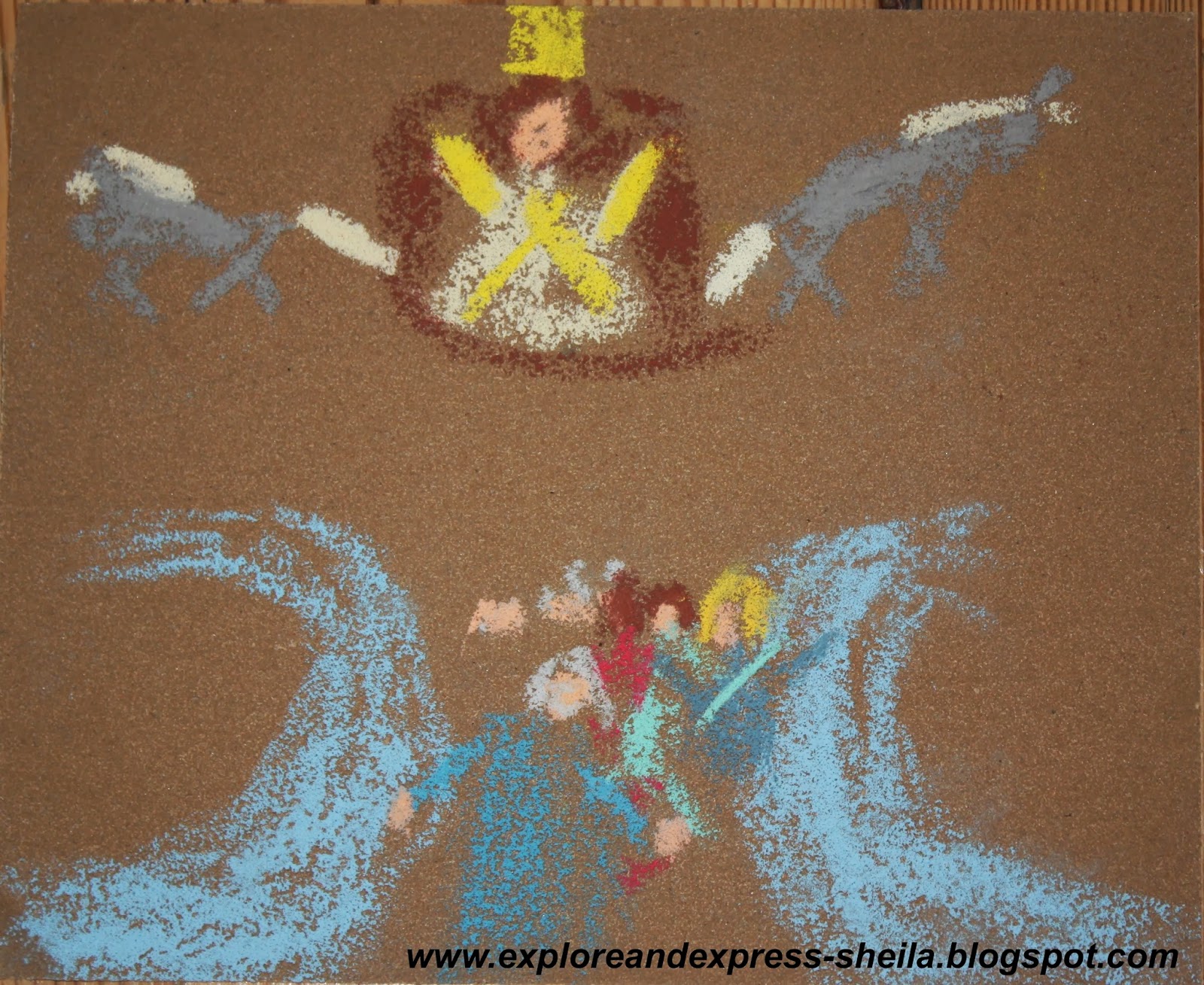
One child drew the picture below with chalk pastels on sand paper during the Response Time. She explained that the people of God are coming through the waters at the bottom of the picture, and that Pharoah (the figure at the top) is pursuing them with his horses and chariot. It's so rare that a child draws something related to what they have just heard, that I had to share it. Obviously, she needed to think about it more. 


Linked to Montessori Monday at Living Montessori Now

Sunday, October 27, 2013

Learning to Fly: Core Training in Minsk

Some of you may remember that I attended a course last December to become an accredited Godly Play Trainer. I also wrote at the time that learning to be a trainer would be a process and a journey - just like everything else in life. (And yes, the title of this post is both a metaphor for this journey and an allusion to the Pink Floyd song!)

I got my feet wet a week and a half ago in Minsk, Belarus helping train 10 new storytellers from Minsk, Moscow and Central Asia. My colleague, Heidi from Wittenberg, and I co-led the training after months of preparation. Not only was this our first time to lead a training since becoming certified, but we had to do it all in Russian! That aspect made it more fun, but way more challenging as well. 


Core Trainings are really meant for people who have read the books, have a basic understanding of GP, and been practicing on their own for a while. In fact, in the UK and Germany, it is required to attend a "Taster Day" where you get introduced to the basics, before you can attend a core training. And one of the reasons that this training was so successful was that our dear friend, Helen Spencer, from Teach Beyond, had already laid a foundation with this group of women by having taught several workshops over the course of the last two years. And almost all of them have been using Godly Play regularly in their work with children. 

Heidi, my Co-Trainer, and I

Heidi and I arrived in Minsk in the evening, grabbed something quickly to eat, and started the training a half hour later! After a "getting acquainted" round, Heidi spoke about creating sacred space for children and the set-up of a Godly Play room. But a GP Core Training is not about sitting around and listening to lots of theory - it's very practical and hands-on. So as our first assignment for the ladies, we put all of the story materials in the middle of the floor and asked them to arrange them in the correct places in the room.


Here I am teaching on the elements of a Godly Play session using a visual aid that I learned from Rebecca Nye at my Trainers' Training.


In between the theory, Heidi, Helen and I presented stories from each genre. Here Helen presents the Parable of the Great Pearl. Nastya, who is sitting beside her and translating, organized the logistics of the training for us. 


Then, it was time for the participants to get to work! They each picked a story and then had about an hour to prepare. Afterward each presented her story to the larger group with a "Wondering" session at the end. 

Here Irena presents the Parable of the Good Shepherd. 


Sveta's presentation of the Baptism story was one of the most beautiful renderings of that story that I have ever seen!


This is Asmic from Amazing and Amusing presenting the "Circle of the Church Year". This is one of the hardest stories to do at a training, because the text is long and the wooden blocks can be awkward to handle the first time. But Asmic managed to tell the whole story by heart and with grace!


When Tanya got ready to prepare "The Holy Family", we realized that I had forgotten the wooden Risen Jesus/Cross in Germany! So we quickly improvised and made a 3-D one using paper and wooden corks. 


Tanya also did a great job with her story and we all got a lesson in preparing materials in the process!


There were gifts, storyteller certificates and many wonderful memories at the end! 


I will always remember this stop on my journey with Godly Play, and pray that God would bring long-lasting fruit in the lives of many children through our work! 


Thursday, October 17, 2013

Off to Minsk!

Today, I'm flying to Minsk, Belarus to co-lead a Godly Play Core Training with Heidi, my colleague from Wittenberg! We will both be leading for the first time in Russian, so we would appreciate your thoughts and prayers.

We are very excited about connecting with the ladies there and supporting them on their Godly Play journey. I'll give you an update when I return!

All Saints' Orthodox Church in Minsk
Royalty Free Stock Photo courtesy of 123RF